Cervical radiculopathy happens when a nerve root in the neck is pinched as it leaves the spinal canal. It causes pain, pins and needles or weakness that travels down the arm, often in a very specific pattern depending on which nerve is affected.
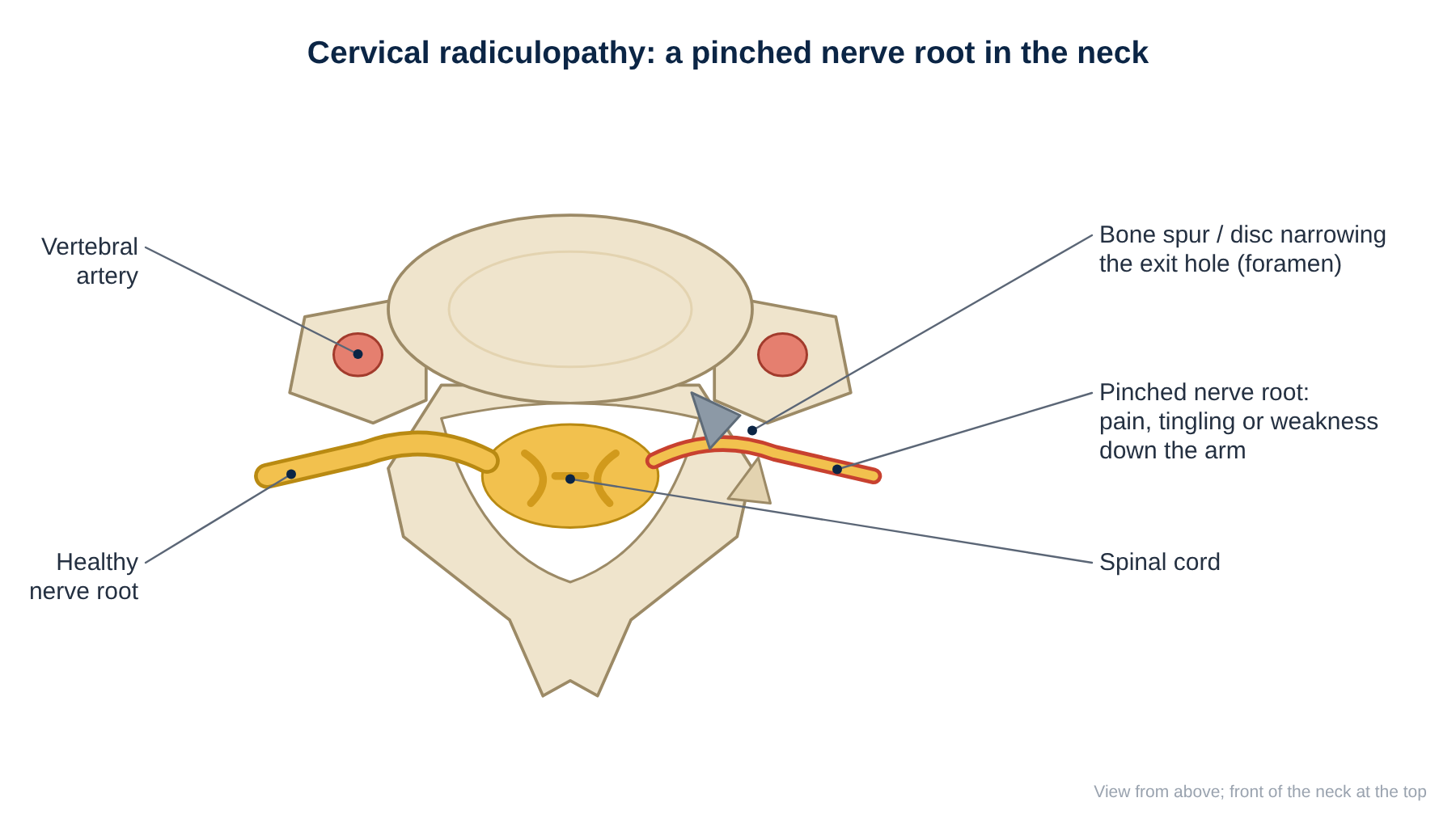
At a glance
- Usually caused by a disc prolapse in younger adults and by bone spurs (spondylosis) in older adults.
- Arm pain is typically worse than neck pain.
- Most people (about 75 to 90%) improve without surgery over weeks to months.
- Surgery gives faster and more reliable relief when pain persists or there is significant weakness.
Symptoms
- Sharp or burning pain from the neck into the shoulder blade, arm and hand.
- Tingling or numbness in particular fingers. For example, a C6 nerve affects the thumb and index finger, and a C7 nerve affects the middle finger.
- Weakness of certain arm or hand muscles, or reduced reflexes.
- Pain made worse by looking up or turning the head towards the painful side, and often eased by resting the hand on top of the head.
When to seek urgent help
If you have arm symptoms together with clumsy hands, difficulty walking or balance problems, problems with bladder control, or symptoms in both arms or legs, the spinal cord may be involved. Please seek prompt specialist assessment (see cervical myelopathy).
Risk factors
- Age-related cervical disc degeneration.
- Heavy lifting, especially overhead.
- Smoking.
- Driving and occupations with vibration exposure.
- Previous neck surgery or injury.
How is it diagnosed?
A clinical examination of strength, sensation and reflexes usually identifies the affected nerve. MRI confirms the cause and level. Nerve conduction studies are sometimes used to exclude conditions such as carpal tunnel syndrome, which can cause similar symptoms.
Non-surgical treatment
- Time and reassurance: the pain often peaks in the first few weeks and then gradually improves.
- Medication: anti-inflammatories and nerve-pain medication. A short course of oral steroids is sometimes used.
- Physiotherapy can help with comfort while the nerve settles. Once the acute pain eases, non-impact cardio such as stationary cycling or walking is the best exercise; neck stretching and strengthening are not needed.
- Image-guided nerve-root (selective) or epidural steroid injection for severe pain.
- A soft collar for a few days can ease severe pain but should not be used long term.
Surgical options
Surgery is recommended if pain remains severe after about 6 to 12 weeks, if there is significant or progressive weakness, or if there are signs of spinal cord compression.

Endoscopic or microscopic posterior foraminotomy
Through a small incision at the back of the neck, the surgeon enlarges the exit hole and removes bone spurs or a disc fragment to free the nerve. No fusion or implant is needed and neck movement is preserved. It is best suited to compression on one side caused by a foraminal disc or bone spur.
Anterior cervical discectomy and fusion (ACDF)
The most common operation for cervical radiculopathy. Through a small incision at the front of the neck, the disc and any spurs are removed to free the nerve, and a spacer is inserted so that the two vertebrae fuse together. Arm pain improves in more than 90% of well-selected patients.
Cervical disc replacement
Instead of fusing the level, an artificial disc is inserted after removing the problem disc. This preserves movement and may reduce stress on neighbouring discs. It suits younger patients without significant arthritis of the facet joints or instability.
What the evidence says: Surgery versus non-surgical care
In a Swedish trial (Persson and colleagues, Spine 1997), surgery gave faster pain relief at 4 months, but surgical, physiotherapy and collar groups were similar at one year. A later Swedish trial (Engquist and colleagues) found that ACDF plus physiotherapy gave better arm and neck pain relief than physiotherapy alone at 2 years, with benefits still present 5 to 8 years later.
What the evidence says: Fusion, disc replacement or foraminotomy?
Large US FDA trials of cervical disc replacement found outcomes at least equivalent to ACDF, with fewer additional operations at the treated and neighbouring levels at 7 to 10 years. The Dutch FACADE trial (Broekema and colleagues, 2020) found that posterior foraminotomy was as effective as ACDF for one-sided radiculopathy at one year.
Recovery
After anterior surgery, most patients go home the next day. Temporary swallowing discomfort and hoarseness are common and usually settle in a few weeks. Office work is often possible within 2 to 4 weeks. Numbness and weakness can take several months to recover fully.
Talk to Prof Kruger
If you are living with this condition and would like an opinion on your options, you are welcome to book a consultation. Please bring any recent scans and reports.
References and key studies
- Radhakrishnan K, et al. Epidemiology of cervical radiculopathy: a population-based study from Rochester, Minnesota, 1976 through 1990. Brain. 1994;117(2):325–335.
- Persson LC, Carlsson CA, Carlsson JY. Long-lasting cervical radicular pain managed with surgery, physiotherapy, or a cervical collar: a prospective, randomized study. Spine. 1997;22(7):751–758.
- Engquist M, et al. Surgery versus nonsurgical treatment of cervical radiculopathy: a prospective, randomized study comparing surgery plus physiotherapy with physiotherapy alone with a 2-year follow-up. Spine. 2013;38(20):1715–1722.
- Engquist M, et al. A 5- to 8-year randomized study on the treatment of cervical radiculopathy: anterior cervical decompression and fusion plus physiotherapy versus physiotherapy alone. J Neurosurg Spine. 2017;26(1):19–27.
- Broekema AEH, et al. Noninferiority of posterior cervical foraminotomy vs anterior cervical discectomy with fusion for procedural success and reduction in arm pain among patients with cervical radiculopathy at 1 year: the FACADE randomized clinical trial. JAMA Neurol. 2020;77(6):749–756.
- Gornet MF, et al. Cervical disc arthroplasty: 10-year outcomes of the Prestige LP cervical disc at a single level. J Neurosurg Spine. 2019;31(3):317–325.
This page is general patient education based on published research and is not a substitute for a personal consultation. Treatment is always tailored to the individual.