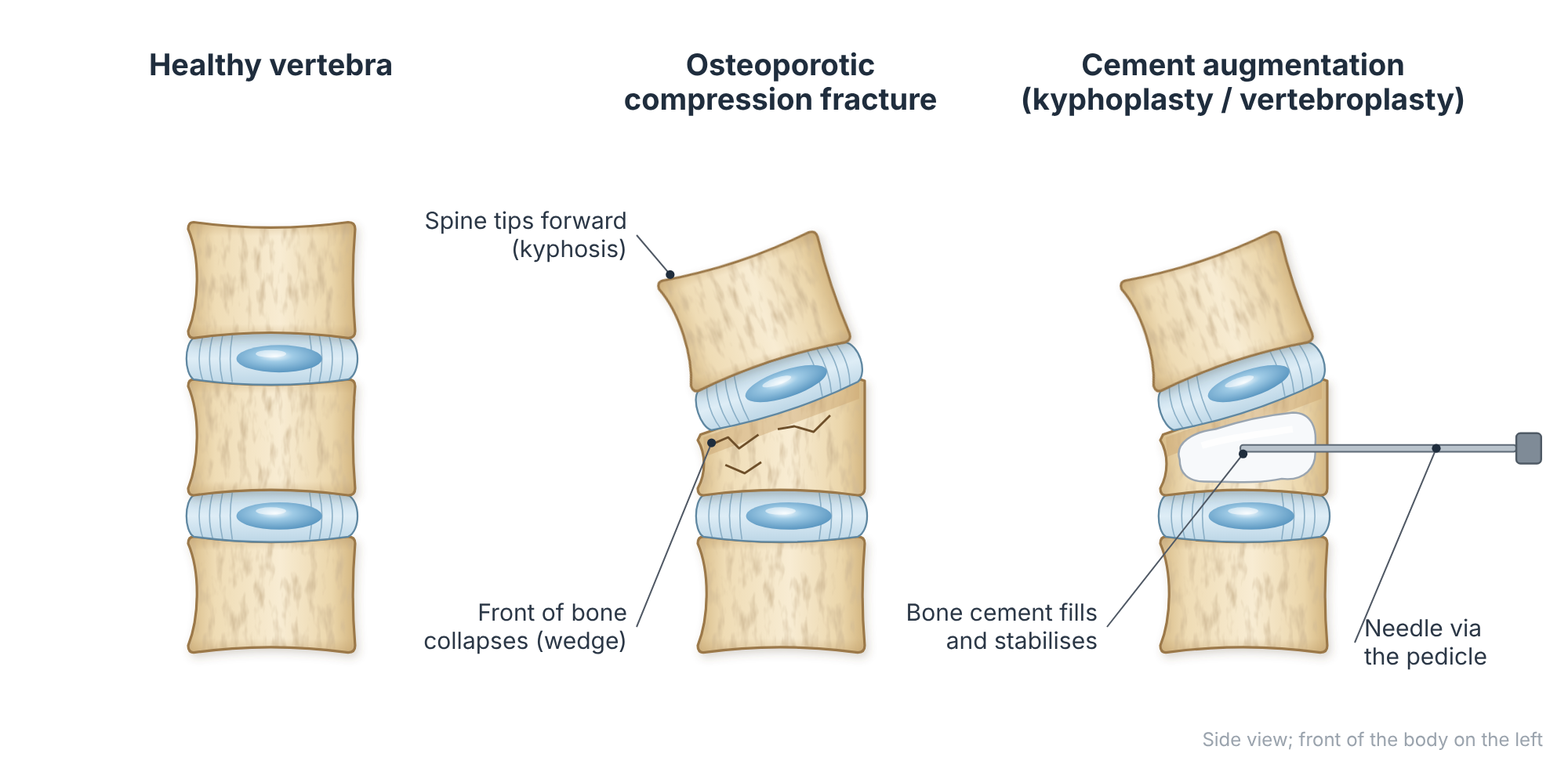
Osteoporosis makes bones thin and fragile. In the spine, a weakened vertebra can collapse, often after a minor fall, lifting a shopping bag, or even a cough or sneeze. This is called an osteoporotic vertebral compression fracture. It is the most common fracture caused by osteoporosis.
At a glance
- About 1 in 5 women and 1 in 10 men over 50 will have a spinal fracture.
- Up to two-thirds are not diagnosed at the time, because pain may be mild or mistaken for “back strain”.
- One spinal fracture greatly increases the risk of further fractures, so bone-strengthening treatment is essential.
- Most fractures heal in 6 to 12 weeks with pain relief and activity. Cement augmentation helps selected patients with severe, persistent pain.
Causes
- Osteoporosis: post-menopausal bone loss, ageing, and low body weight.
- Medication: long-term steroid use, some breast and prostate cancer treatments, and certain anti-epileptic drugs.
- Medical conditions: rheumatoid arthritis, thyroid or parathyroid overactivity, coeliac disease, kidney disease and low vitamin D.
- Lifestyle: smoking, excess alcohol and inactivity.
- Other bone-weakening conditions, such as multiple myeloma or metastases, must be excluded when a fracture occurs without a clear reason.
Symptoms
- Sudden onset of back pain, often in the mid-back or around the thoracolumbar junction, after a minor event.
- Pain that is worse on standing, walking and turning in bed, and eased by lying still.
- Pain that may wrap around the chest or abdomen.
- Gradual loss of height and an increasingly stooped posture (sometimes called a “dowager’s hump”) after several fractures.
- Rarely, leg weakness or numbness if bone fragments press on nerves.
How is it diagnosed?
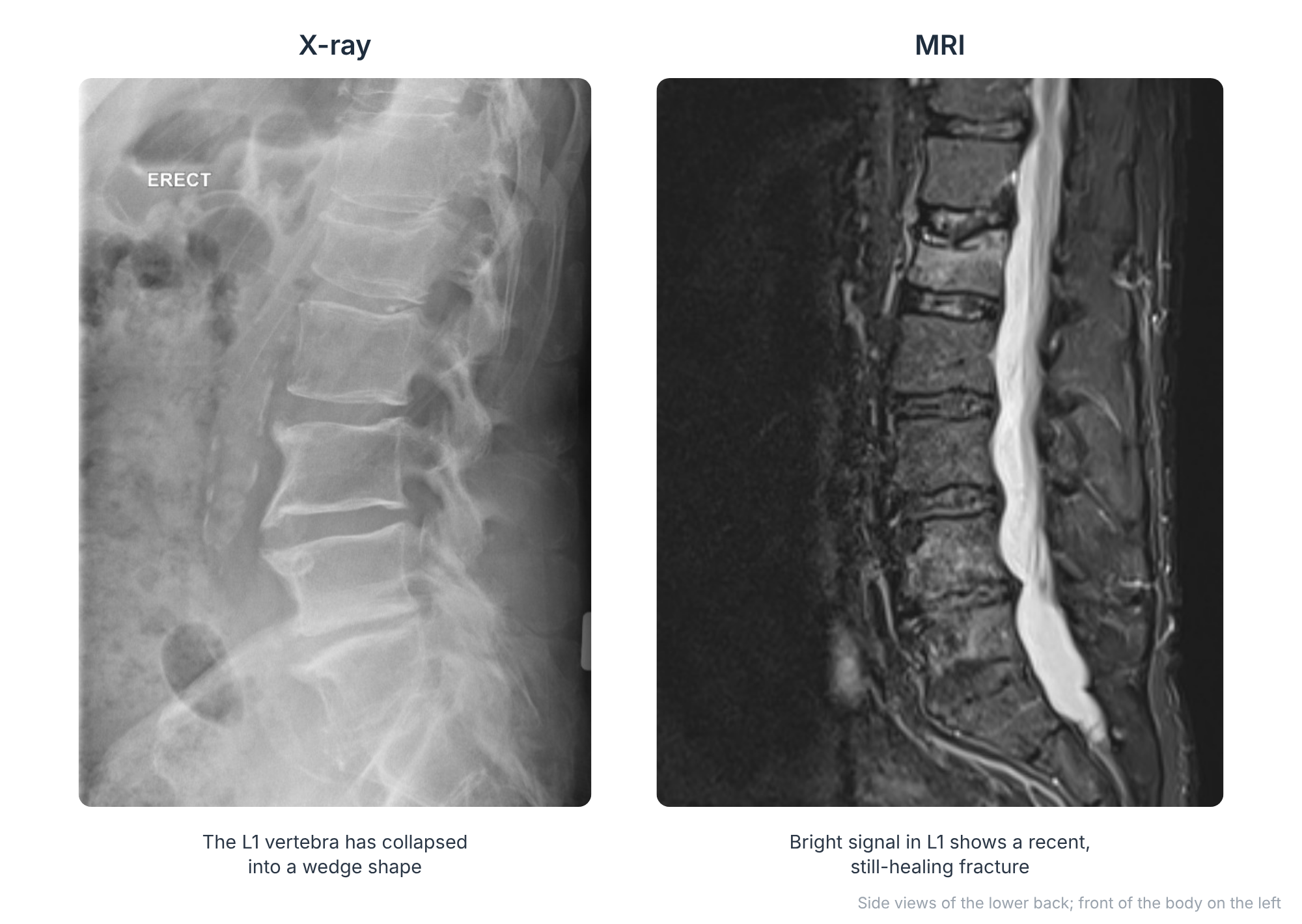
X-rays show the fracture, and MRI shows whether it is recent (bone oedema) and excludes other causes. A bone-density (DEXA) scan and blood tests assess the osteoporosis and look for underlying causes.
Treatment
Pain relief and early mobilisation
Most fractures heal by themselves. Treatment includes pain medication, short periods of rest followed by gentle walking, physiotherapy to help you get moving safely, and sometimes a soft brace for comfort. Prolonged bed rest should be avoided because it weakens bone and muscle further.
Anti-osteoporotic medication: preventing the next fracture
Treating the underlying osteoporosis is the most important long-term step. Effective options include:
- Calcium and vitamin D as a foundation for all treatment.
- Bisphosphonates (alendronate tablets weekly or zoledronic acid infusion yearly), which reduce new spinal fractures by roughly 50 to 70%.
- Denosumab, an injection every 6 months, which reduced new spinal fractures by 68% in the FREEDOM trial. It must not be stopped suddenly without follow-on treatment because of a rebound risk of fractures.
- Bone-building (anabolic) drugs: teriparatide (daily injections for up to 2 years) and romosozumab (monthly injections for 12 months). These are preferred for people at very high risk or who already have spinal fractures, followed by a bisphosphonate or denosumab.
- Falls prevention: exercise for strength and balance, home safety and review of medication.
What the evidence says: Building bone beats slowing loss in high-risk patients
In the VERO trial (Kendler and colleagues, Lancet 2018), teriparatide reduced new vertebral fractures by more than half compared with risedronate in women with severe osteoporosis. In the ARCH trial (Saag and colleagues, NEJM 2017), romosozumab followed by alendronate reduced new vertebral fractures by 48% compared with alendronate alone.
Cement vertebral body augmentation
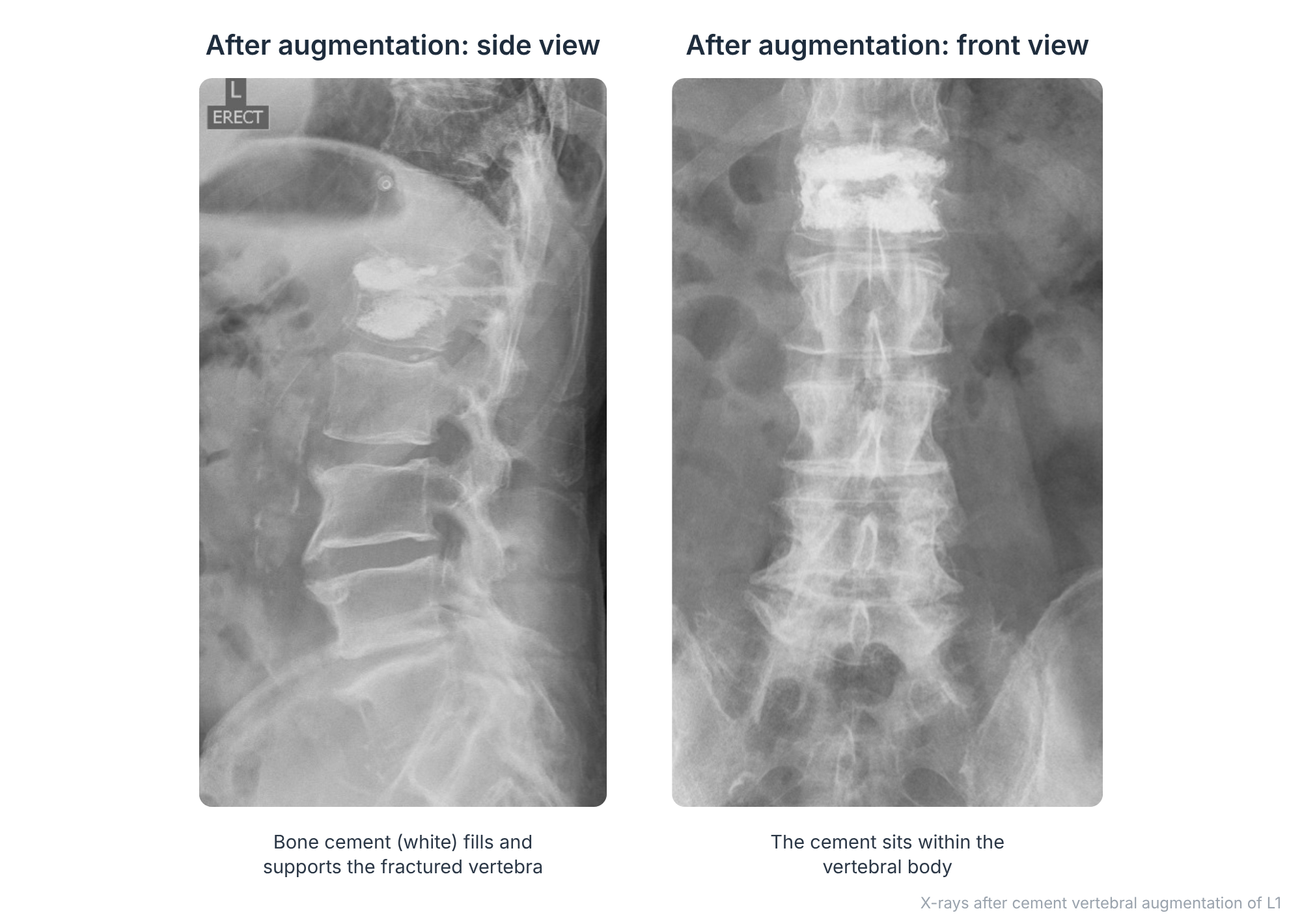
- Vertebroplasty: bone cement is injected through a needle into the fractured vertebra to stabilise it.
- Kyphoplasty (balloon kyphoplasty): a balloon is first inflated inside the vertebra to create a cavity and partly restore height, then filled with cement.
Both are performed through small skin punctures under X-ray guidance, usually as day-case or overnight procedures. They are considered for patients with severe pain from a recent fracture that is not controlled with medication, those who cannot mobilise, or when the fracture continues to collapse.
What the evidence says: What do the cement trials show?
The evidence is mixed. Two sham-controlled trials in 2009 (Buchbinder; Kallmes) found no benefit over a placebo procedure in patients with fractures up to a year old. However, trials of more acute, severely painful fractures showed benefit: VERTOS II (Klazen, Lancet 2010) found better and faster pain relief with vertebroplasty, and VAPOUR (Clark, Lancet 2016) found vertebroplasty superior to a sham procedure for fractures less than 6 weeks old. The FREE trial (Wardlaw, Lancet 2009) showed kyphoplasty gave faster improvement in quality of life than non-surgical care. VERTOS IV (Firanescu, BMJ 2018) found no benefit over sham. The current view is that cement augmentation helps carefully selected patients with acute, severe pain, rather than everyone with a fracture.
Surgery
Open or minimally invasive surgery with screws and rods is rarely needed. It is reserved for fractures with nerve or spinal cord compression, instability or progressive deformity. Because osteoporotic bone holds screws poorly, screws are often reinforced with cement.
Endoscopic surgery and disc replacement
These techniques are not used for osteoporotic fractures.
Outlook
Pain from most fractures improves significantly within 6 to 12 weeks. The key long-term goal is to prevent further fractures with effective osteoporosis treatment, which every patient with a spinal fragility fracture should be offered.
Talk to Prof Kruger
If you are living with this condition and would like an opinion on your options, you are welcome to book a consultation. Please bring any recent scans and reports.
References and key studies
- Black DM, et al. Randomised trial of effect of alendronate on risk of fracture in women with existing vertebral fractures (FIT). Lancet. 1996;348(9041):1535–1541.
- Black DM, et al. Once-yearly zoledronic acid for treatment of postmenopausal osteoporosis (HORIZON). N Engl J Med. 2007;356(18):1809–1822.
- Cummings SR, et al. Denosumab for prevention of fractures in postmenopausal women with osteoporosis (FREEDOM). N Engl J Med. 2009;361(8):756–765.
- Kendler DL, et al. Effects of teriparatide and risedronate on new fractures in post-menopausal women with severe osteoporosis (VERO). Lancet. 2018;391(10117):230–240.
- Saag KG, et al. Romosozumab or alendronate for fracture prevention in women with osteoporosis (ARCH). N Engl J Med. 2017;377(15):1417–1427.
- Buchbinder R, et al. A randomized trial of vertebroplasty for painful osteoporotic vertebral fractures. N Engl J Med. 2009;361(6):557–568.
- Kallmes DF, et al. A randomized trial of vertebroplasty for osteoporotic spinal fractures. N Engl J Med. 2009;361(6):569–579.
- Klazen CA, et al. Vertebroplasty versus conservative treatment in acute osteoporotic vertebral compression fractures (VERTOS II). Lancet. 2010;376(9746):1085–1092.
- Clark W, et al. Safety and efficacy of vertebroplasty for acute painful osteoporotic fractures (VAPOUR). Lancet. 2016;388(10052):1408–1416.
- Wardlaw D, et al. Efficacy and safety of balloon kyphoplasty compared with non-surgical care for vertebral compression fracture (FREE). Lancet. 2009;373(9668):1016–1024.
- Firanescu CE, et al. Vertebroplasty versus sham procedure for painful acute osteoporotic vertebral compression fractures (VERTOS IV). BMJ. 2018;361:k1551.
This page is general patient education based on published research and is not a substitute for a personal consultation. Treatment is always tailored to the individual.