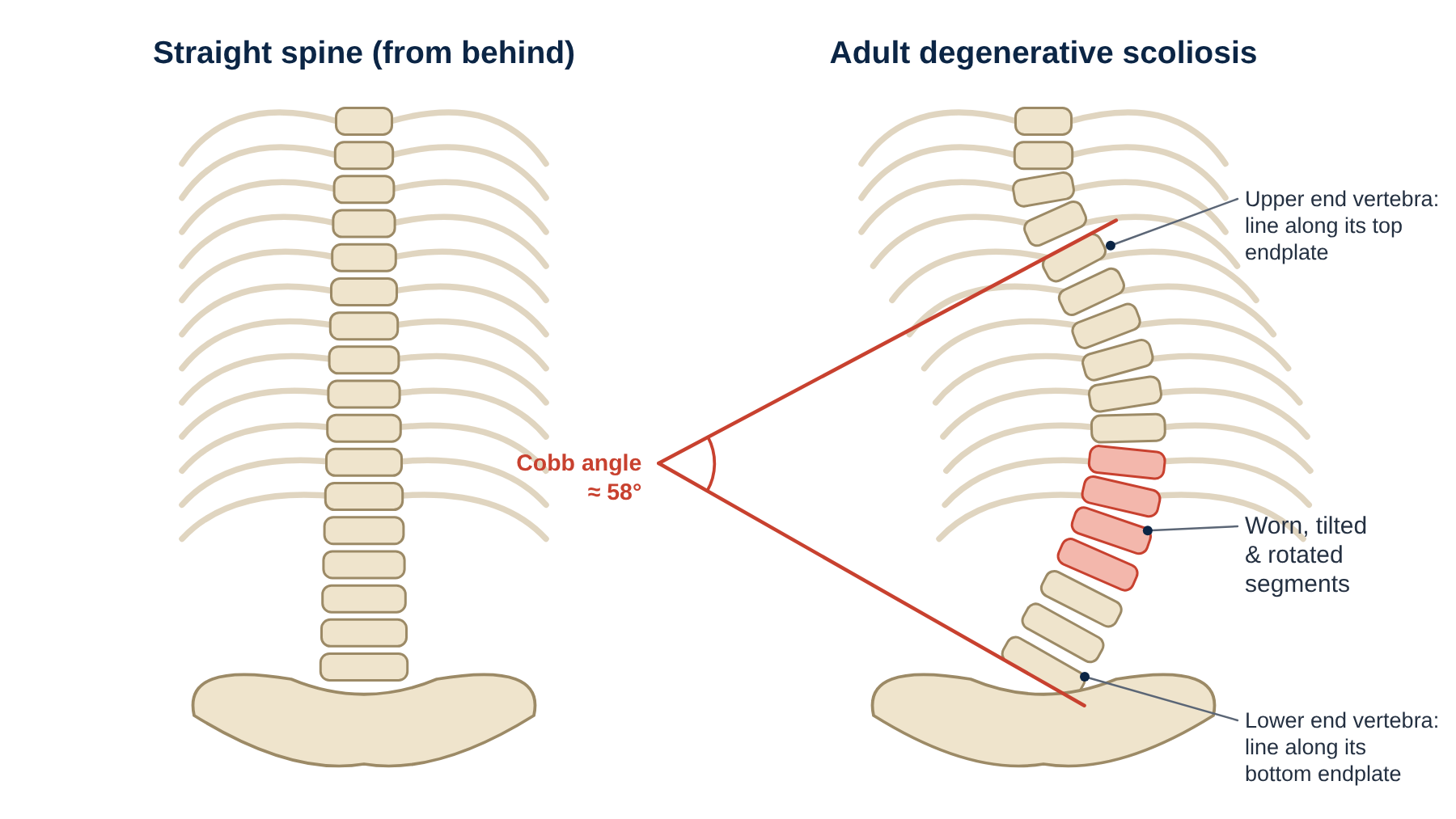
Scoliosis is a sideways curve of the spine. In adults, it is either a curve that began in adolescence and has progressed, or a new curve that develops in later life as the discs and joints wear unevenly (degenerative or “de novo” scoliosis). Adult scoliosis can cause back pain, leg pain and a feeling of leaning forwards or to one side.
At a glance
- Very common: many people over 60 have a measurable curve, most without major symptoms.
- Symptoms come from worn joints, pinched nerves and imbalance rather than the curve itself.
- Forward or sideways imbalance (losing the ability to stand upright comfortably) causes the most disability.
- Most people are treated without surgery. Surgery can greatly improve quality of life for well-selected patients, but it is major surgery with a significant complication rate.
Symptoms
- Lower back pain and stiffness, often worse later in the day.
- Leg pain, numbness or heaviness on walking (from spinal stenosis).
- Leaning forward or to one side, needing to bend the knees or use a walking aid to stand upright.
- Fatigue from the effort of standing straight.
- Visible changes: a rib or waist asymmetry, or loss of height.
Risk factors
- Age over 50, disc degeneration and facet joint arthritis.
- Osteoporosis and vertebral fractures.
- Adolescent idiopathic scoliosis that progresses in adulthood.
- Previous spinal surgery.
How is it diagnosed?
Full-length standing X-rays from the front and side measure the curve (the Cobb angle) and, importantly, the overall balance of the spine and pelvis. MRI shows nerve compression, and CT or bone-density scans help in planning surgery.
Non-surgical treatment
- Non-impact cardio: walking, stationary cycling or swimming for fitness and pain relief. Stretching and core programmes cannot straighten an arthritic curve and are not needed.
- Pain medication and anti-inflammatory medicines.
- Injections: nerve-root or epidural injections for leg pain, and facet injections for back pain.
- Bone health: osteoporosis assessment and treatment where needed.
- Weight management and staying active.
- Braces may provide short-term comfort but do not correct adult curves.
Surgical options
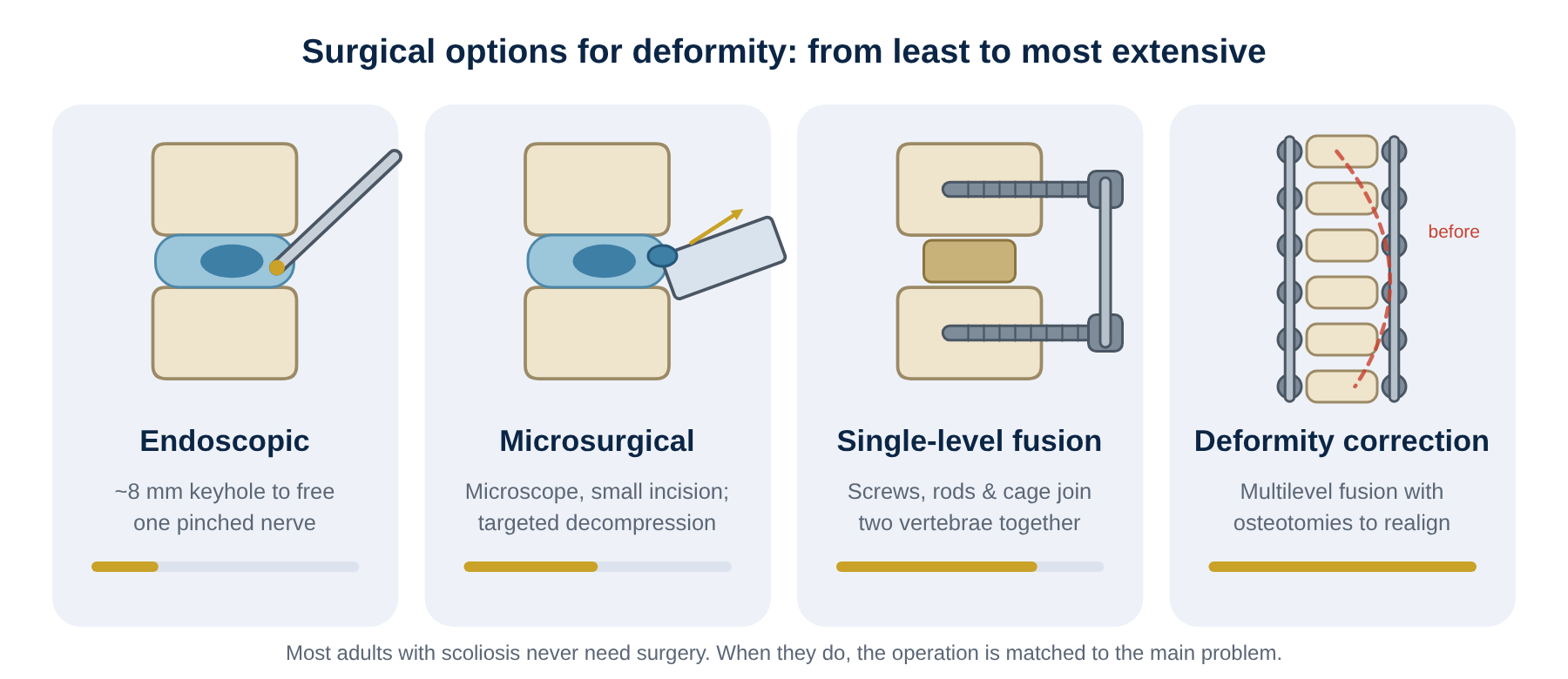
Surgery is considered when pain or imbalance substantially limits daily life despite non-surgical care, or when there is progressive deformity or neurological deficit. The operation is tailored to the main problem.
Endoscopic or minimally invasive decompression
If the main problem is leg pain from one pinched nerve and the spine is well balanced, a limited decompression can relieve symptoms without a large operation. Care is needed not to destabilise the curve.
Single-level fusion
For a focal problem, such as a slipped segment within the curve, a short fusion may be enough.

Deformity correction with multilevel fusion
For significant curves with imbalance, screws and rods are placed over many levels, often down to the pelvis. Osteotomies (bone cuts) and interbody cages, sometimes inserted from the side (lateral interbody fusion) or front, are used to restore the normal curves and balance. Minimally invasive techniques are increasingly used for selected patients.

Disc replacement
Disc replacement is not suitable for scoliosis because the segments are already unstable and arthritic.
What the evidence says: The ASLS study
The NIH-funded Adult Symptomatic Lumbar Scoliosis (ASLS) study (Kelly and colleagues, JBJS 2019) compared surgery with non-surgical care in patients aged 40 to 80. Patients who had surgery showed large improvements in pain and function at 2 years, while those treated non-surgically, on average, did not improve. However, complications were common, and a substantial proportion of surgical patients needed further surgery.
What the evidence says: Alignment matters
Research by the International Spine Study Group and others (Schwab and colleagues) showed that restoring sagittal (side-view) balance, rather than simply straightening the curve, is most closely linked to good outcomes after adult deformity surgery.
Recovery
Recovery after major deformity surgery is a process over 6 to 12 months. Hospital stay is usually 5 to 7 days, followed by a gradual return to walking and daily activities. A thorough pre-operative assessment, including bone health, nutrition, heart and lung function, and stopping smoking, helps reduce the risks.
Talk to Prof Kruger
If you are living with this condition and would like an opinion on your options, you are welcome to book a consultation. Please bring any recent scans and reports.
References and key studies
- Schwab F, et al. Adult scoliosis: prevalence, SF-36, and nutritional parameters in an elderly volunteer population. Spine. 2005;30(9):1082–1085.
- Schwab F, et al. Scoliosis Research Society–Schwab adult spinal deformity classification: a validation study. Spine. 2012;37(12):1077–1082.
- Kelly MP, et al. Operative versus nonoperative treatment for adult symptomatic lumbar scoliosis. J Bone Joint Surg Am. 2019;101(4):338–352.
- Smith JS, et al. Operative versus nonoperative treatment of leg pain in adults with scoliosis: a retrospective review of a prospective multicenter database with two-year follow-up. Spine. 2009;34(16):1693–1698.
This page is general patient education based on published research and is not a substitute for a personal consultation. Treatment is always tailored to the individual.