Cervical myelopathy occurs when the spinal cord in the neck is squeezed by worn discs, bone spurs or thickened ligaments. The spinal cord carries messages between the brain and the body, so pressure on it can affect the hands, walking and balance. It usually develops gradually, and early symptoms are easy to dismiss as “getting older”.
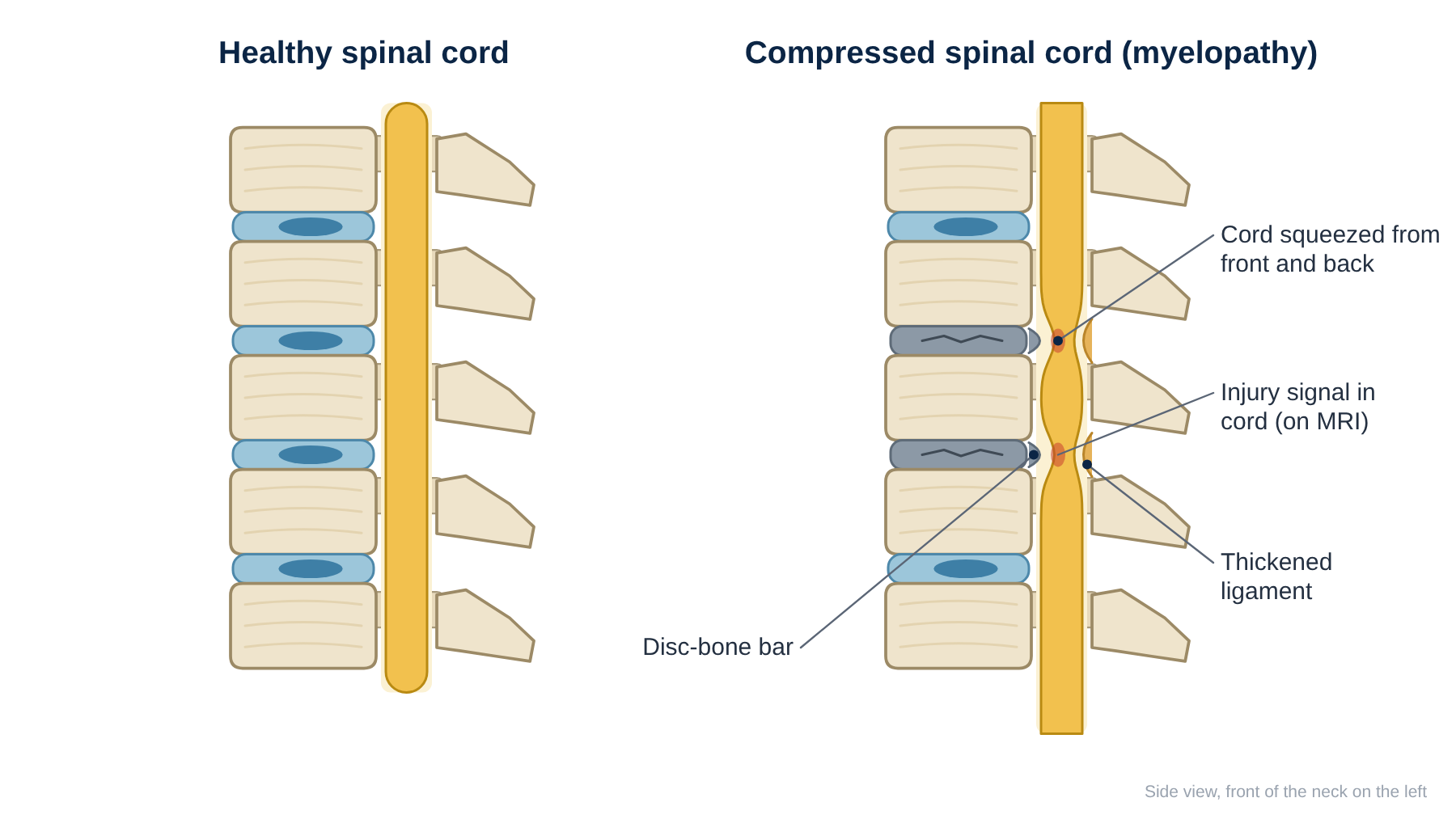
At a glance
- Also called degenerative cervical myelopathy (DCM). It is the most common cause of spinal cord problems in adults.
- Typical symptoms: clumsy hands, numb fingers, unsteady walking.
- Untreated, it often gets worse step by step, and lost function may not fully recover.
- Surgery is recommended for moderate and severe myelopathy and is effective at stopping progression and improving function.
Symptoms
- Numb, clumsy hands. Difficulty with buttons, writing, using a phone or picking up coins.
- Dropping objects.
- Unsteady or wide-based walking, and feeling that the legs do not respond normally.
- Electric-shock sensations down the spine or limbs when bending the neck (Lhermitte’s sign).
- Neck stiffness, which is not always present.
- In more advanced cases, urinary urgency or incontinence.
Do not ignore these signs
Progressive hand clumsiness, falls or worsening balance in someone with neck arthritis should be assessed promptly. Early surgery gives the best chance of recovery.
Risk factors
- Age over 50 and advanced cervical spondylosis.
- A naturally narrow spinal canal.
- Ossification of the posterior longitudinal ligament (OPLL), more common in people of East Asian descent.
- Previous neck injury, and conditions such as Down syndrome and rheumatoid arthritis that affect the upper neck.
How is it diagnosed?
A neurological examination looks for signs of spinal cord involvement, such as brisk reflexes, a Hoffmann sign and abnormal gait. MRI shows the level and severity of compression and any signal change within the cord. Severity is graded using the modified Japanese Orthopaedic Association (mJOA) score, which helps to guide treatment.
Treatment
Non-surgical treatment
For mild myelopathy, guidelines support either surgery or a trial of structured rehabilitation with close monitoring. Avoiding high-risk activities that could injure the neck is advisable. If symptoms progress, surgery is recommended. Non-surgical treatment is not advised for moderate or severe myelopathy.
Surgical options
The goal of surgery is to relieve pressure on the spinal cord and stop further damage. The approach depends on the number of levels involved, the alignment of the neck and where the compression comes from.

- Anterior cervical discectomy and fusion (ACDF): removes the disc and spurs from the front at one to three levels.
- Anterior corpectomy: removes part of a vertebral body when compression lies behind the bone itself.
- Cervical disc replacement: in selected patients with disc-level compression and preserved movement.
- Laminoplasty: opens the bony arch at the back like a hinged door to give the cord more room while keeping movement. It is useful for multi-level compression when the neck has a normal curve.
- Laminectomy and posterior fusion: removes the bony arch and stabilises with screws and rods, which is suitable for multi-level disease, especially with instability or loss of the normal curve.
- Endoscopic and minimally invasive techniques are developing for selected single-level compression, but most myelopathy surgery is performed with open microsurgical techniques because of the need for wide, safe decompression.
What the evidence says: Surgery improves function
The AOSpine CSM-North America and International studies (Fehlings and colleagues), which included over 700 patients, showed significant improvements in function, disability and quality of life after surgery at all levels of severity. International guidelines published in 2017 recommend surgery for moderate and severe myelopathy, and either surgery or supervised rehabilitation for mild myelopathy.
What the evidence says: Front or back?
The CSM-S randomised trial (Ghogawala and colleagues, JAMA 2021) compared anterior and posterior surgery for multi-level myelopathy. Both approaches gave similar improvement in physical function at one year. Complications differed: swallowing problems were more common after anterior surgery. The approach is therefore tailored to each patient’s anatomy.
Recovery
The main aim of surgery is to prevent further deterioration, and most patients also improve. Hand function and walking often get better over 6 to 12 months, but nerve damage that was present for a long time may not fully recover. This is why early treatment matters.
Talk to Prof Kruger
If you are living with this condition and would like an opinion on your options, you are welcome to book a consultation. Please bring any recent scans and reports.
References and key studies
- Fehlings MG, et al. Efficacy and safety of surgical decompression in patients with cervical spondylotic myelopathy: results of the AOSpine North America prospective multi-center study. J Bone Joint Surg Am. 2013;95(18):1651–1658.
- Fehlings MG, et al. A clinical practice guideline for the management of patients with degenerative cervical myelopathy: recommendations for patients with mild, moderate, and severe disease and nonmyelopathic patients with evidence of cord compression. Global Spine J. 2017;7(3 Suppl):70S–83S.
- Ghogawala Z, et al. Effect of ventral vs dorsal spinal surgery on patient-reported physical functioning in patients with cervical spondylotic myelopathy: a randomized clinical trial. JAMA. 2021;325(10):942–951.
- Kadaňka Z, et al. Approaches to spondylotic cervical myelopathy: conservative versus surgical results in a 3-year follow-up study. Spine. 2002;27(20):2205–2210.
- Davies BM, et al. Degenerative cervical myelopathy. BMJ. 2018;360:k186.
This page is general patient education based on published research and is not a substitute for a personal consultation. Treatment is always tailored to the individual.