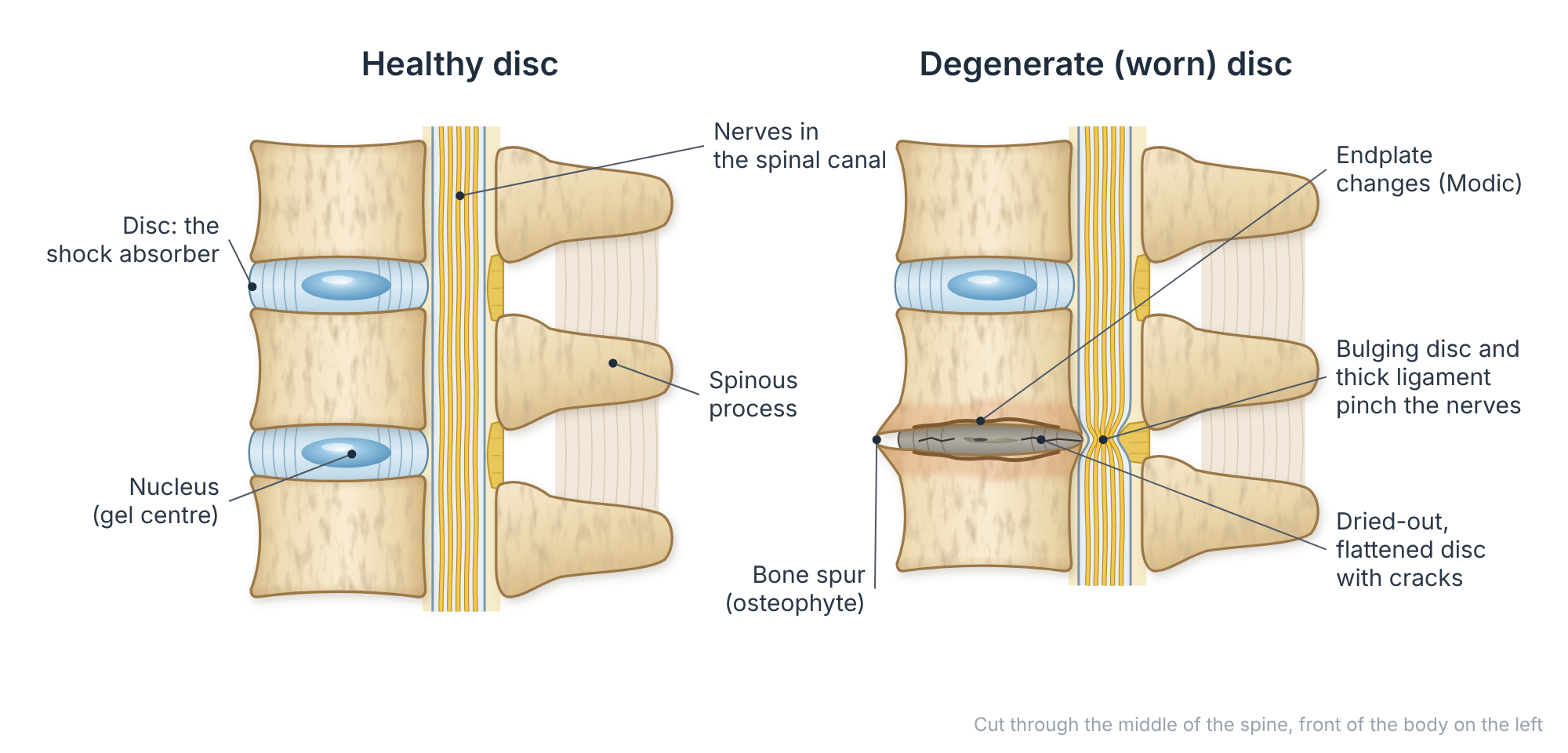
The discs between the bones of your lower back act as shock absorbers. With time they dry out, lose height and can develop small tears. This is called disc degeneration. It is a normal part of ageing, and for most people it causes little or no trouble, but for some it is a source of persistent low back pain.
At a glance
- Very common: MRI shows disc degeneration in about a third of pain-free 20-year-olds and in over 90% of pain-free people over 60.
- A “worn disc” on a scan does not automatically explain back pain, so the scan must be matched to your symptoms.
- Most episodes of back pain improve substantially within 6 to 8 weeks, whatever treatment is used, although some people have lingering or recurring symptoms.
- Surgery has a limited, carefully selected role for back pain caused by degeneration alone.
What is disc degeneration?
Each disc has a tough outer ring (the annulus) and a soft gel-like centre (the nucleus). From early adulthood the nucleus gradually loses water. The disc becomes thinner and stiffer, the ring can develop cracks, and the bone next to the disc (the endplate) may react with inflammation, seen on MRI as “Modic changes”. Bone spurs (osteophytes) form as the body tries to stabilise the segment.
These changes are sometimes called “degenerative disc disease”, but it is not really a disease. It is better thought of as the spine’s equivalent of grey hair or wrinkles.
Symptoms
- An ache in the lower back, often worse with sitting, bending or lifting and eased by changing position or walking.
- Stiffness in the morning or after long periods in one position.
- Episodes of more severe pain (“flare-ups”) that settle over days to weeks.
- Pain that may spread into the buttocks. Pain that runs below the knee, with pins and needles or numbness, suggests a pinched nerve (see disc prolapse and spinal stenosis).
Risk factors
- Age and genetics. Family history is one of the strongest predictors.
- Smoking, which reduces blood supply to the disc.
- Being overweight.
- Heavy repetitive lifting, vibration (e.g. long-distance driving) and physically demanding work.
- Previous injury or disc surgery at that level.
How is it diagnosed?
Diagnosis starts with a careful history and examination. X-rays show disc height and alignment, and MRI shows the hydration of the disc, any nerve compression and endplate (Modic) changes. Because degeneration is so common in people without pain, the key question is not “is there degeneration?” but “does it explain your symptoms?”
Non-surgical (conservative) treatment
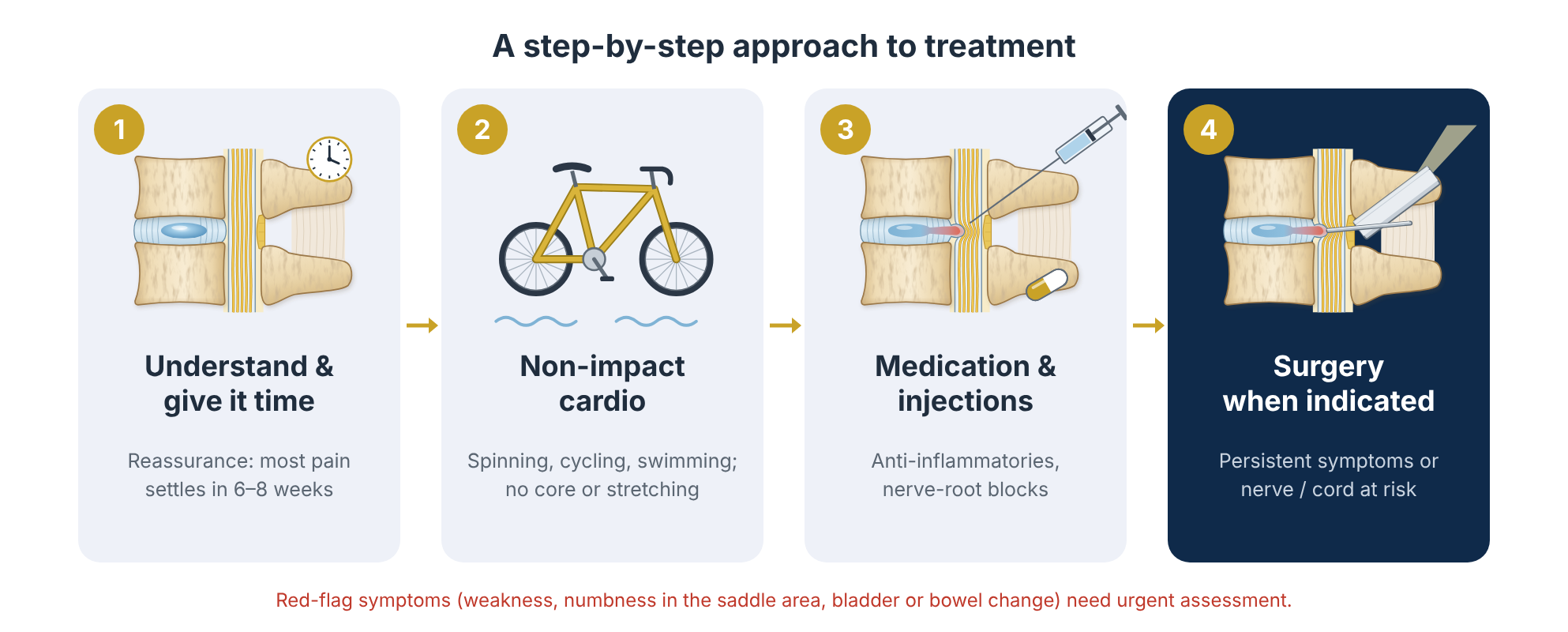
- Education and staying active. Bed rest slows recovery; gentle activity speeds it up.
- Non-impact cardio, not core work. Regular spinning, cycling or swimming, hard enough to raise your heart rate to around 75 to 80% of your maximum (220 minus your age), releases endorphins that ease pain and lift mood. Core exercises, planking, sit-ups, stretching and spinal loading are not needed and may aggravate stiff, worn segments. See Spinal health and common sense.
- Pain medication. Short courses of anti-inflammatories or simple analgesics during flare-ups. Long-term opioids are not recommended.
- Weight loss and stopping smoking reduce load on the spine and the inflammation linked to disc degeneration. A weight-loss programme is probably the most underrated treatment for back pain.
- Psychological approaches such as cognitive-behavioural therapy help people manage persistent pain and are part of recommended “combined physical and psychological” programmes.
- Injections and radiofrequency procedures can help in selected cases, for example facet joint denervation when the small joints at the back of the spine are the main source of pain.
Surgical options
Surgery is considered only when pain is severe, has persisted despite a good-quality rehabilitation programme, and the painful level can be clearly identified.
Endoscopic and minimally invasive procedures
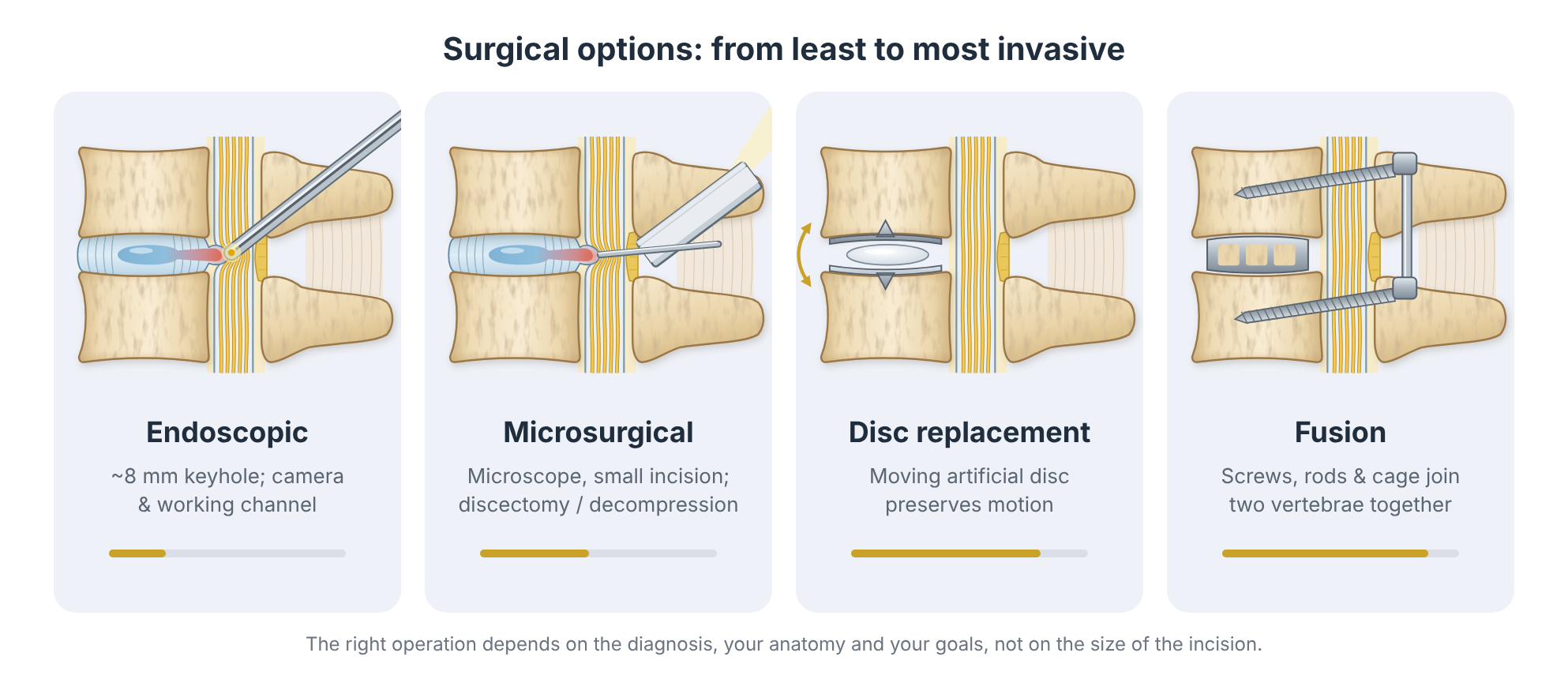
Keyhole techniques using a camera through an incision of roughly 8 mm are mainly used to treat nerve compression (disc prolapse or stenosis) rather than back pain from degeneration alone. Newer targeted treatments, such as ablation of the nerve inside the vertebra (basivertebral nerve ablation) for pain associated with Modic changes, are under study and are only suitable for carefully selected patients.
Decompression
Decompression removes bone, ligament or disc that is pressing on a nerve. It treats leg pain from nerve compression very well, but it does not treat back pain caused by a worn disc.
Spinal fusion
Fusion joins two or more vertebrae together with screws, rods and a spacer (cage) so that the painful segment no longer moves. Randomised trials comparing fusion with a high-quality, intensive rehabilitation programme for chronic back pain found broadly similar results, while fusion carries surgical risks. Fusion is therefore reserved for selected patients, for example those with instability or deformity.
Disc replacement
An artificial disc replaces the worn disc while keeping movement at that level. Large trials showed results at least as good as fusion in carefully selected patients (usually younger adults with a single degenerate disc and healthy facet joints). It is not suitable if there is significant arthritis of the facet joints, osteoporosis or instability.
What the evidence says: Fusion and disc replacement for back pain
In the Swedish Lumbar Spine Study, fusion gave more improvement than standard non-surgical care. However, the UK MRC trial and a Norwegian trial found that fusion was no better than an intensive rehabilitation programme combining exercise and cognitive therapy. A Norwegian randomised trial of disc replacement versus rehabilitation found a statistically significant benefit with surgery, although it was smaller than the trial’s target for a clearly worthwhile improvement. This is why surgery for degeneration-related back pain is offered selectively and only after thorough rehabilitation.
Outlook
Most people with disc degeneration lead full, active lives. Symptoms tend to fluctuate, and many people find that pain improves in later decades as the spine naturally stiffens. Keeping fit, maintaining a healthy weight and avoiding smoking are the most valuable long-term measures.
When to seek urgent help
Seek urgent medical attention if back pain is accompanied by numbness around the genitals or buttocks (“saddle” area), new difficulty passing or controlling urine or stool, progressive leg weakness, fever, unexplained weight loss, or a history of cancer.
Talk to Prof Kruger
If you are living with this condition and would like an opinion on your options, you are welcome to book a consultation. Please bring any recent scans and reports.
References and key studies
- Brinjikji W, et al. Systematic literature review of imaging features of spinal degeneration in asymptomatic populations. AJNR Am J Neuroradiol. 2015;36(4):811–816.
- Fritzell P, et al. Lumbar fusion versus nonsurgical treatment for chronic low back pain: a multicenter randomized controlled trial from the Swedish Lumbar Spine Study Group. Spine. 2001;26(23):2521–2532.
- Fairbank J, et al. Randomised controlled trial to compare surgical stabilisation of the lumbar spine with an intensive rehabilitation programme for patients with chronic low back pain: the MRC spine stabilisation trial. BMJ. 2005;330:1233.
- Brox JI, et al. Randomized clinical trial of lumbar instrumented fusion and cognitive intervention and exercises in patients with chronic low back pain and disc degeneration. Spine. 2003;28(17):1913–1921.
- Zigler J, et al. Results of the prospective, randomized, multicenter FDA IDE study of the ProDisc-L total disc replacement versus circumferential fusion. Spine. 2007;32(11):1155–1162.
- Hellum C, et al. Surgery with disc prosthesis versus rehabilitation in patients with low back pain and degenerative disc: two year follow-up of randomised study. BMJ. 2011;342:d2786.
- National Institute for Health and Care Excellence. Low back pain and sciatica in over 16s: assessment and management (NG59). 2016, updated 2020.
This page is general patient education based on published research and is not a substitute for a personal consultation. Treatment is always tailored to the individual.