A surgical site infection is an infection of the wound or the deeper tissues after spinal surgery. It is uncommon, but early recognition and treatment are important, particularly when screws, rods or cages have been used.

At a glance
- Occurs after roughly 1 to 4% of spinal operations, more often after longer operations with implants.
- Most infections appear within the first 2 to 6 weeks, but low-grade infections can appear months or years later.
- Early infections can usually be cured by washing out the wound and giving antibiotics, while keeping the implants in place.
- Many simple measures before and around the time of surgery reduce the risk.
Symptoms
- Increasing pain at the wound after an initial improvement.
- Redness, warmth or swelling around the incision.
- Fluid or pus leaking from the wound, or the wound opening up.
- Fever, chills or feeling generally unwell.
- Late infection: new or worsening back pain months after surgery, sometimes with loosening of screws or failure of the fusion to heal.
Contact your surgeon promptly
If you notice wound discharge, fever or worsening pain after spinal surgery, please contact your surgeon’s rooms or go to hospital. Do not wait for your next scheduled follow-up.
Risk factors
- Patient factors: diabetes (particularly if poorly controlled), obesity, smoking, malnutrition, older age, steroid use, rheumatoid arthritis, HIV with a low CD4 count, and previous spinal surgery or infection.
- Surgical factors: long operations, multi-level fusions, revision surgery, surgery for trauma or tumour, blood loss and transfusion.
- Colonisation of the skin or nose with bacteria such as Staphylococcus aureus (including MRSA).
Prevention
- Optimising diabetes control, nutrition and weight before planned surgery.
- Stopping smoking at least 4 to 6 weeks before surgery.
- Antibiotics given within an hour before the incision.
- Careful skin preparation, and sometimes screening and treatment for nasal Staphylococcus carriage.
- Meticulous surgical technique, minimising operating time and blood loss, and careful wound closure.
- Some surgeons place antibiotic powder (vancomycin) in the wound for high-risk operations. Studies give mixed results, so this is used selectively.
How is it diagnosed?
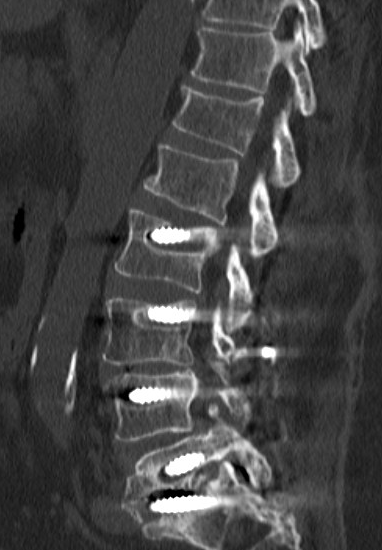
Diagnosis is based on the appearance of the wound, blood tests (white cell count, CRP and ESR) and imaging. MRI or CT can show deep fluid collections. Samples taken from the wound or during surgery identify the bacteria so that antibiotics can be targeted. Low-grade infections, often caused by skin bacteria such as Cutibacterium acnes, can be subtle and require prolonged laboratory cultures.
Treatment
Superficial infection
Infection limited to the skin and fat may respond to oral antibiotics and wound care.
Deep infection: surgical washout and debridement
Most deep infections need a return to theatre. The wound is opened, infected tissue is removed and the area is thoroughly washed out. In early infection, the implants are usually left in place, because they are needed to hold the spine stable while it fuses. Sometimes more than one washout is needed, and a negative-pressure (vacuum) dressing may be used to help the wound heal.
Antibiotics
Antibiotics are tailored to the bacteria identified, usually started intravenously and then continued as tablets. Treatment for implant-related infection typically lasts at least 6 to 12 weeks, and longer suppressive courses are sometimes used until the fusion is solid.
Late infection
For infections that appear after the fusion has healed, the implants can often be removed to clear the infection. If the fusion has not healed, the implants may be exchanged and the spine re-stabilised.
Endoscopic surgery and disc replacement
Endoscopic techniques can sometimes be used to wash out and sample deep infections after keyhole surgery. Disc replacement has no role in treating infection.
What the evidence says: Outcomes
Studies show that most early deep infections after instrumented spinal fusion are cured with debridement, implant retention and targeted antibiotics, and patients’ final outcomes are often comparable to those without infection. Late or multiply resistant infections are more difficult and may require implant removal.
Outlook
With prompt treatment, the large majority of post-operative spinal infections are cured and the fusion goes on to heal. Early reporting of wound problems is the single most important thing patients can do.
Talk to Prof Kruger
If you are living with this condition and would like an opinion on your options, you are welcome to book a consultation. Please bring any recent scans and reports.
References and key studies
- Dowdell J, et al. Postoperative spine infection: diagnosis and management. Global Spine J. 2018;8(4 Suppl):37S–43S.
- Tubaki VR, Rajasekaran S, Shetty AP. Effects of using intravenous antibiotic only versus local intrawound vancomycin antibiotic powder application in addition to intravenous antibiotics on postoperative infection in spine surgery in 907 patients. Spine. 2013;38(25):2149–2155.
- Bratzler DW, et al. Clinical practice guidelines for antimicrobial prophylaxis in surgery. Am J Health Syst Pharm. 2013;70(3):195–283.
- Berbari EF, et al. 2015 IDSA clinical practice guidelines for the diagnosis and treatment of native vertebral osteomyelitis in adults. Clin Infect Dis. 2015;61(6):e26–e46.
This page is general patient education based on published research and is not a substitute for a personal consultation. Treatment is always tailored to the individual.