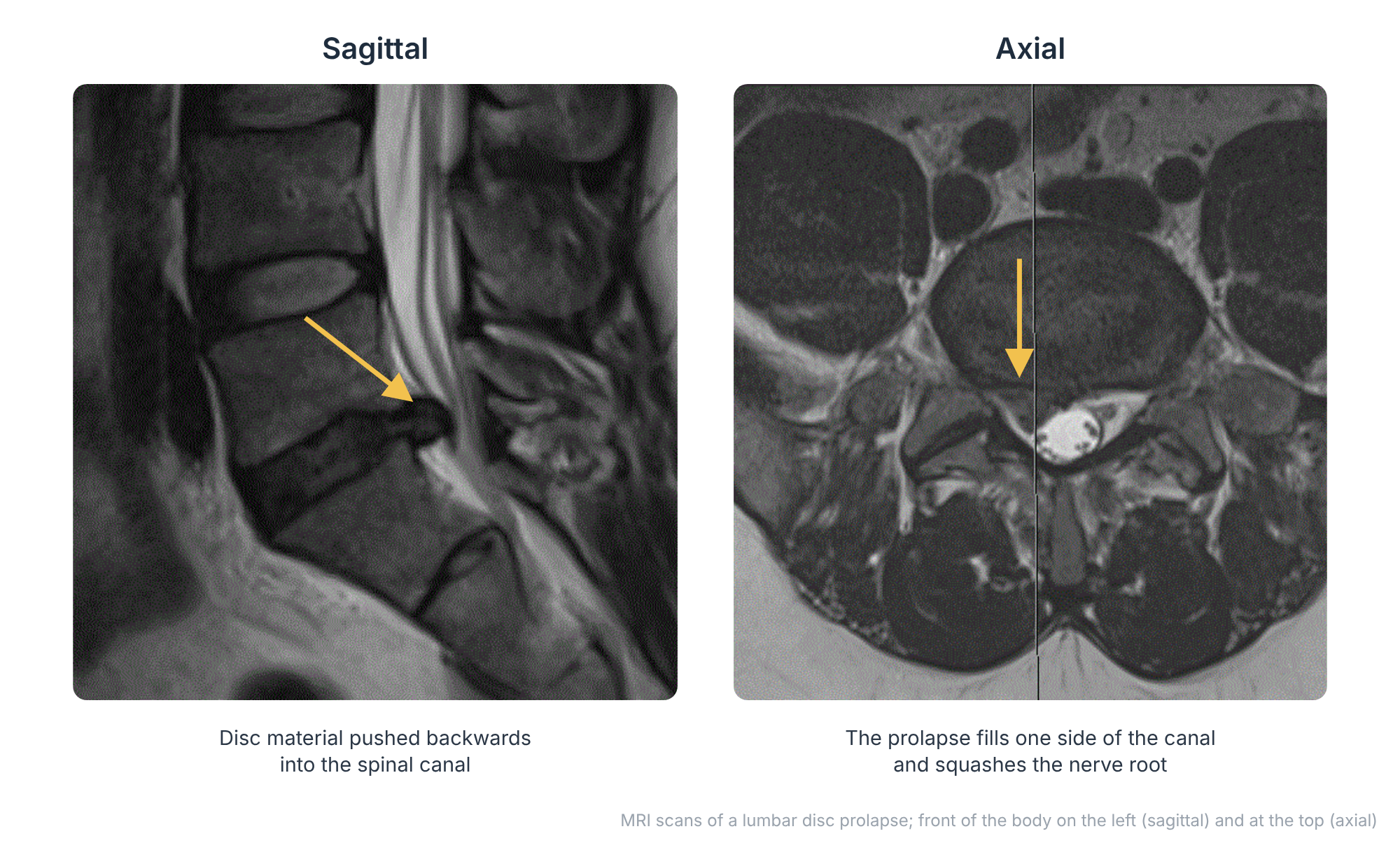
A disc prolapse (also called a herniated or “slipped” disc) happens when some of the soft centre of a disc pushes out through a tear in its outer wall. If it presses on a nerve root, it causes pain that shoots down the leg. This is known as sciatica.

At a glance
- Most common between 30 and 50 years of age, usually at the two lowest discs (L4/5 and L5/S1).
- Leg pain is usually worse than back pain.
- Most people improve without surgery within 6 to 12 weeks, and the herniated disc material often shrinks on its own.
- Surgery (microdiscectomy or endoscopic discectomy) gives faster relief for persistent or severe sciatica.
What happens in a disc prolapse?
When the outer ring of a disc weakens or tears, the gel-like nucleus can bulge or squeeze out. The escaped material presses on the nerve and also releases chemicals that inflame it. That is why a prolapse can be so painful even when the bulge is small. The body often recognises the escaped disc material as foreign and gradually reabsorbs it, which is one reason many people recover without an operation.
Symptoms
- Sharp, burning or electric pain running from the buttock down the back or side of the leg, often to the foot (sciatica).
- Pins and needles or numbness in part of the leg or foot.
- Weakness, for example difficulty walking on the heels or toes, or a “foot drop”.
- Pain made worse by sitting, coughing, sneezing or bending forward.
- Back pain, which is often less severe than the leg pain.
Cauda equina syndrome: an emergency
Go to an emergency department immediately if you develop numbness around the genitals, buttocks or inner thighs, new difficulty passing urine or loss of bladder or bowel control, or weakness in both legs. A large disc prolapse can compress the bundle of nerves at the bottom of the spine and needs urgent surgery.
Risk factors
- Age 30 to 50, when the disc nucleus is still gel-like but the outer ring has begun to weaken.
- Heavy lifting, especially combined with twisting.
- Smoking and obesity.
- Prolonged sitting and driving.
- Family history of disc problems.
How is it diagnosed?
Your surgeon will ask about your symptoms and examine the nerves of your legs (strength, sensation, reflexes and the straight-leg raise test). An MRI scan is the best test to confirm a prolapse and is usually reserved for symptoms lasting more than 6 weeks, or sooner if there is weakness or red-flag symptoms.
Non-surgical treatment
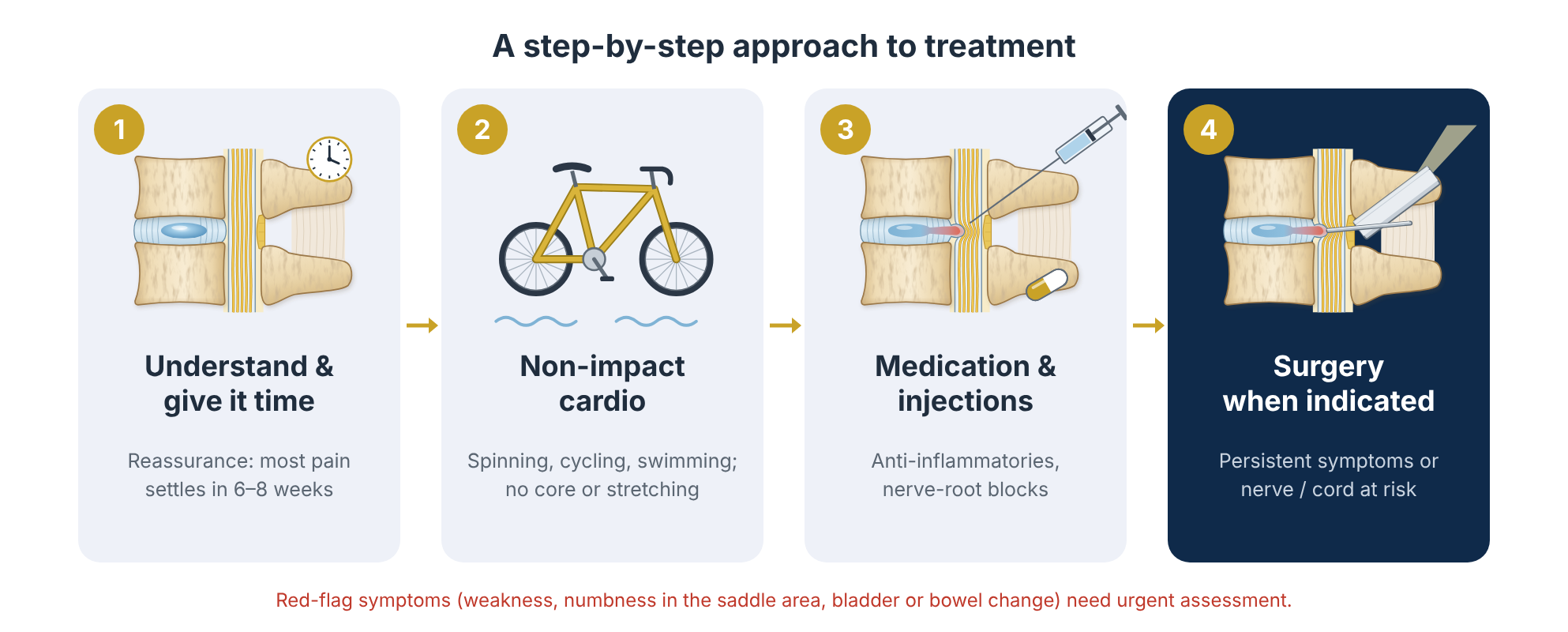
- Stay as active as pain allows. Short rest periods are fine, but prolonged bed rest is not helpful.
- Pain relief: anti-inflammatories and, for nerve pain, medicines that calm irritated nerves.
- Non-impact cardio: once the worst pain settles, walking, stationary cycling or swimming, kept pain-free. Physiotherapy can give comfort and reassurance while the disc settles, but stretching and core exercises are not needed.
- Epidural or nerve-root steroid injection: can reduce leg pain for several weeks and help people through the worst phase while the disc settles. The benefit is mainly short-term.
Surgical options
Surgery is considered when leg pain remains severe after about 6 to 12 weeks, when there is significant or worsening weakness, or urgently for cauda equina syndrome. The goal is to remove the fragment pressing on the nerve. The disc itself is not replaced.
Endoscopic discectomy
Through an incision of roughly 8 mm, a camera and fine instruments are passed to the disc to remove the herniated fragment. Muscle disruption is minimal and most patients go home the same day or the next morning. A large Dutch trial found that endoscopic discectomy relieved leg pain at least as well as open microdiscectomy at one year, with slightly better early recovery. Results depend on the surgeon’s experience with the technique and on where the fragment lies.
Microdiscectomy (open microsurgical)
The standard operation for disc prolapse. Through a small incision and using a microscope, the surgeon gently moves the nerve aside and removes the loose disc fragment. Most patients notice immediate improvement in leg pain.
Decompression and fusion
Fusion is not needed for a simple disc prolapse. It may be considered if the prolapse recurs several times at the same level, or if there is instability or significant degeneration.
Disc replacement
Disc replacement is not a treatment for sciatica from a disc prolapse. It is occasionally considered for back pain from a degenerate disc in carefully selected patients (see disc degeneration).
What the evidence says: The SPORT trial
The Spine Patient Outcomes Research Trial (SPORT) followed patients with sciatica from a disc prolapse in a randomised trial and a parallel observational group. Both surgery and non-surgical care led to substantial improvement. Patients who had surgery improved faster and had better pain and function scores, an advantage that was still present at 8 years. Because many patients in the randomised arm crossed over between treatments, the safest conclusion is that both are reasonable choices, and surgery offers quicker and somewhat greater relief.
What the evidence says: Timing of surgery
In a Dutch trial (Peul and colleagues, NEJM 2007), early surgery for severe sciatica gave faster relief, but by one year results were similar to prolonged conservative care. For sciatica lasting 4 to 12 months, a Canadian trial (Bailey and colleagues, NEJM 2020) found microdiscectomy gave clearly better leg pain relief than continued non-surgical treatment. Waiting is safe for many patients, but very long delays may reduce the benefit of surgery.
Recovery after surgery
Most people walk on the day of surgery and return to desk work within 2 to 4 weeks, and to heavier work or sport after 6 to 12 weeks. About 5 to 10% of people develop a recurrent prolapse at the same level over the following years. Staying fit with non-impact cardio, keeping a healthy weight and not smoking help to reduce this risk.
Talk to Prof Kruger
If you are living with this condition and would like an opinion on your options, you are welcome to book a consultation. Please bring any recent scans and reports.
References and key studies
- Weinstein JN, et al. Surgical vs nonoperative treatment for lumbar disk herniation: the Spine Patient Outcomes Research Trial (SPORT): a randomized trial. JAMA. 2006;296(20):2441–2450.
- Weinstein JN, et al. Surgical vs nonoperative treatment for lumbar disk herniation: the SPORT observational cohort. JAMA. 2006;296(20):2451–2459.
- Lurie JD, et al. Surgical versus nonoperative treatment for lumbar disc herniation: eight-year results for the Spine Patient Outcomes Research Trial. Spine. 2014;39(1):3–16.
- Peul WC, et al. Surgery versus prolonged conservative treatment for sciatica. N Engl J Med. 2007;356(22):2245–2256.
- Bailey CS, et al. Surgery versus conservative care for persistent sciatica lasting 4 to 12 months. N Engl J Med. 2020;382(12):1093–1102.
- Gadjradj PS, et al. Full endoscopic versus open discectomy for sciatica: randomised controlled non-inferiority trial. BMJ. 2022;376:e065846.
- Chiu CC, et al. The probability of spontaneous regression of lumbar herniated disc: a systematic review. Clin Rehabil. 2015;29(2):184–195.
This page is general patient education based on published research and is not a substitute for a personal consultation. Treatment is always tailored to the individual.