Spondylolysis is a stress fracture through a small bridge of bone at the back of the spine called the pars interarticularis (the “pars”). It most often affects the lowest lumbar vertebra (L5) and is a common cause of lower back pain in young, active people, especially fast bowlers, gymnasts, dancers and rugby players.

At a glance
- Common: about 6% of adults have a pars defect, and most never have symptoms.
- Young athletes: repeated arching and twisting of the lower back (bowling, gymnastics, dancing, rugby) is the usual cause.
- Early stress fractures can heal with a period of rest from sport.
- Most people do well without surgery. Around 4 out of 5 return to their sport with non-surgical treatment.
- Isthmic spondylolisthesis: in some people the cracked vertebra slowly slips forward (see Spondylolisthesis).
Causes
The pars is a thin bridge of bone that takes a great deal of strain when the lower back is arched backwards and twisted. Repeating this movement thousands of times, as in fast bowling or gymnastics, can cause a stress fracture, in the same way that runners develop stress fractures in the shin. Some people are born with a thinner pars, and spondylolysis tends to run in families.
Symptoms
- Lower back pain, often on one side, that is worse when arching backwards, bowling or twisting
- Pain that comes on during sport and eases with rest
- Tight hamstring muscles
- Leg pain is uncommon, but can occur if a slip develops and pinches a nerve
How is it diagnosed?
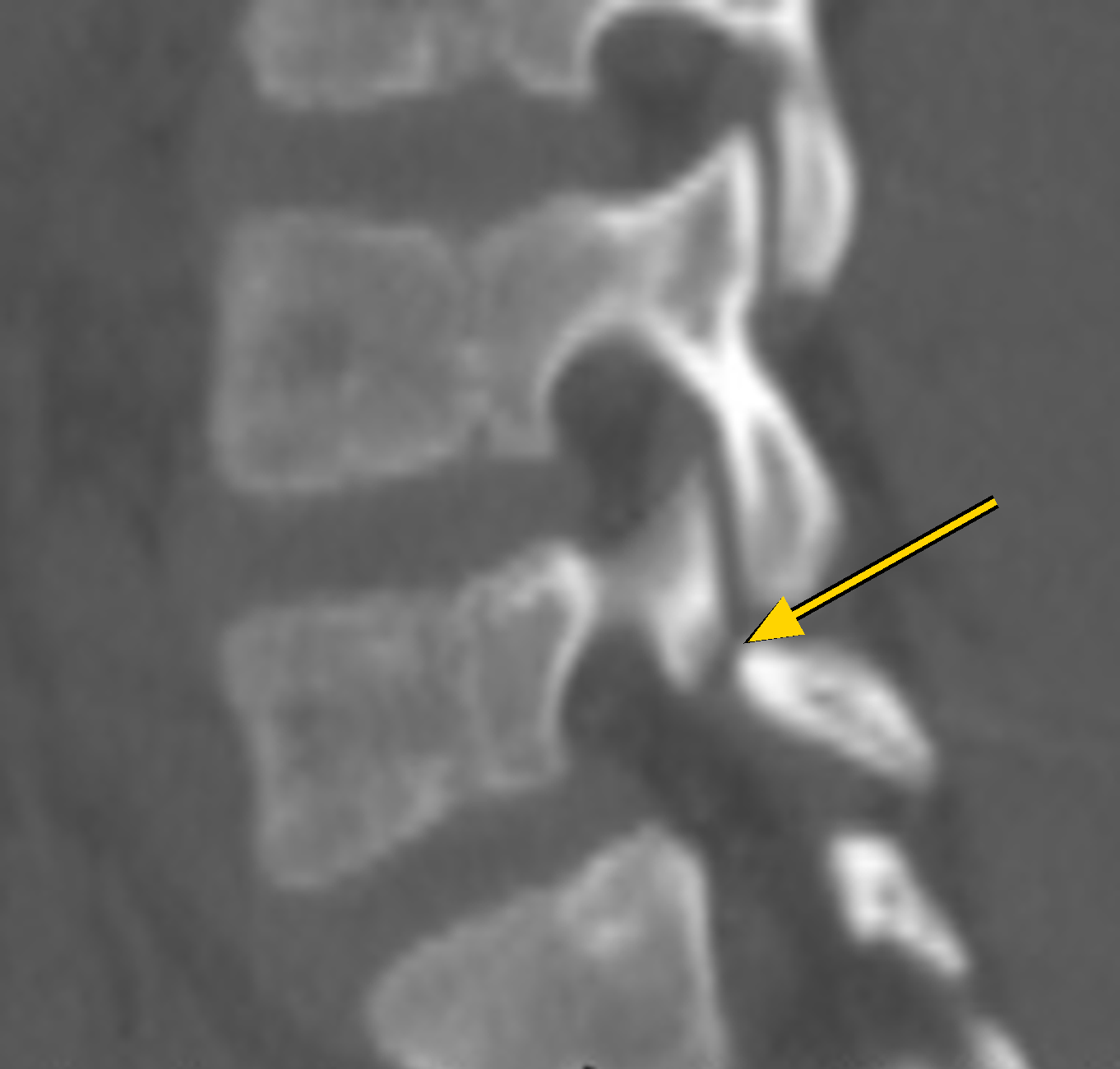
Ordinary X-rays often miss an early stress fracture. An MRI scan shows the stress reaction in the bone at an early stage without radiation, which is why it is preferred in young people. A CT scan shows the crack in the bone clearly and whether it is healing. Standing X-rays show whether the vertebra has started to slip.
Non-surgical treatment
Most people are treated without surgery. The key step is a break from the sport or activity that caused the fracture, usually for around three months, to give an early stress fracture the chance to heal. A brace is sometimes used. Pain relief helps in the short term.
Fitness can be maintained during this time with non-impact cardio such as cycling, spinning or swimming. Return to sport is gradual once pain has settled, and in young bowlers attention to bowling workload and technique helps to prevent a recurrence.
What the evidence says
A meta-analysis of studies on spondylolysis found that about 84% of patients had a successful outcome with non-surgical treatment. Early stress fractures have the best chance of healing; established, long-standing defects rarely heal, but they are often painless.
Surgical options
Surgery is needed only for a small number of people whose pain continues despite a good period of non-surgical treatment.
Pars repair
When the pars fracture has not healed (a non-union) and the patient is young, with no disc degeneration and no slip (spondylolisthesis), a pars repair may be considered. The fracture is cleaned, packed with bone graft and held with screws so that it heals. This preserves movement at that level of the spine.

Fusion
If the vertebra has slipped forward or the disc below is worn, the affected level is fused with screws, rods and a cage. See Spondylolisthesis for more detail.
Outlook
The outlook is very good. Most young athletes return to their sport, and many adults with a pars defect have no symptoms at all. Only a small proportion develop a slip that needs further treatment.
Talk to Prof Kruger
If you or a family member has this condition and would like an opinion on the options, you are welcome to book a consultation. Please bring any recent scans and reports.
References and key studies
- Fredrickson BE, et al. The natural history of spondylolysis and spondylolisthesis. J Bone Joint Surg Am. 1984;66(5):699–707.
- Klein G, et al. Efficacy of surgical and conservative treatment of spondylolysis: a meta-analysis. J Pediatr Orthop. 2009;29(2):146–156.
- Sairyo K, et al. Conservative treatment for pediatric lumbar spondylolysis to achieve bone healing using a hard brace: what type and how long? J Neurosurg Spine. 2012;16(6):610–614.
- Leone A, et al. Lumbar spondylolysis: a review. Skeletal Radiol. 2011;40(6):683–700.
This page is general patient education based on published research and is not a substitute for a personal consultation. Treatment is always tailored to the individual.