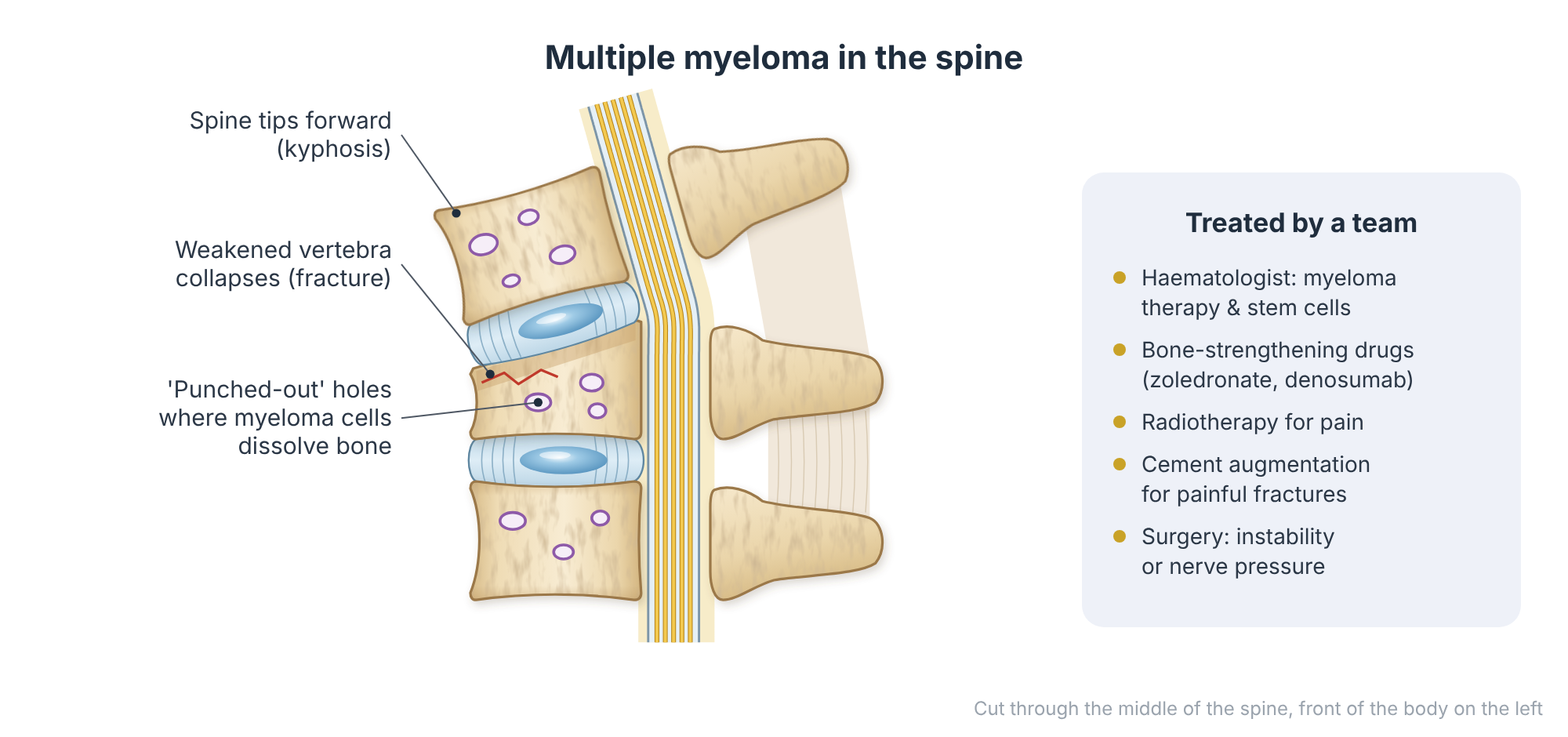
Multiple myeloma is a cancer of plasma cells, a type of white blood cell made in the bone marrow. Myeloma cells activate cells that dissolve bone, creating “punched-out” holes. Because the spine contains a lot of bone marrow, it is the most commonly affected part of the skeleton, and back pain or a spinal fracture is often the first sign of the disease.
At a glance
- Bone disease is present in about 80% of people at diagnosis, and the spine is the most common site.
- Back pain, a fracture after minimal trauma, tiredness (anaemia), kidney problems or high calcium levels can be early signs.
- Treatment is led by a haematologist. The spinal surgeon’s role is to protect stability and the spinal cord.
- Modern treatments have greatly improved survival, and many people live for many years with good quality of life.
Symptoms
- Persistent back pain, often worse at night or on movement.
- Sudden back pain from a spinal fracture after little or no injury.
- Loss of height or a stooped posture from multiple fractures.
- Fatigue, frequent infections, thirst, constipation or confusion (from anaemia, low immunity or high calcium).
- Rarely, leg weakness, numbness or bladder problems from compression of the spinal cord. This is an emergency.
Risk factors
- Age over 60.
- Male sex.
- Being of African descent: myeloma is about twice as common in people of African ancestry.
- A precursor condition called MGUS (monoclonal gammopathy of undetermined significance).
- Family history.
How is it diagnosed?
Blood and urine tests detect the abnormal protein produced by myeloma cells (paraprotein or light chains). A bone marrow biopsy confirms the diagnosis. Whole-body low-dose CT, MRI or PET-CT shows the extent of bone involvement. If a spinal fracture is the first presentation, a biopsy can be taken at the time of cement augmentation.
Treatment
Systemic treatment (haematology)
The disease is controlled with combinations of modern drugs, including proteasome inhibitors, immunomodulatory drugs and antibody therapies, often followed by a stem-cell transplant in suitable patients.
Bone-protective medication
- Zoledronic acid (an intravenous bisphosphonate) or denosumab reduce fractures and bone pain. In the Myeloma IX trial, zoledronic acid also improved survival.
- Calcium and vitamin D supplementation, and dental review before starting treatment.
Radiotherapy
Low-dose radiotherapy is highly effective for painful bone lesions and for shrinking tumour that is pressing on nerves or the spinal cord. Myeloma is very sensitive to radiotherapy.
Bracing and pain relief
A brace may be used for comfort while fractures heal, together with appropriate pain medication.
Cement augmentation (kyphoplasty or vertebroplasty)
For painful myeloma fractures, bone cement can be injected into the collapsed vertebra through small needles. This often gives rapid pain relief, stabilises the bone and allows a biopsy at the same time.
What the evidence says: The CAFE trial
In the CAFE trial (Berenson and colleagues, Lancet Oncology 2011), patients with painful cancer-related spinal fractures, many with myeloma, were randomised to balloon kyphoplasty or non-surgical care. Kyphoplasty gave significantly better improvement in back-related disability and pain at one month, and the benefit was maintained over the following year.
Surgery
Open or minimally invasive surgery with screws and rods is needed less often in myeloma, because the disease usually responds well to drugs and radiotherapy. It is reserved for spinal instability (often assessed using the Spinal Instability Neoplastic Score, or SINS), progressive deformity, or spinal cord compression with neurological deficit, especially if caused by bone fragments rather than soft tumour. Minimally invasive percutaneous screws, often reinforced with cement, reduce recovery time so that cancer treatment is not delayed.
Endoscopic surgery and disc replacement
These techniques are not used in the treatment of myeloma.
What the evidence says: Bisphosphonates in myeloma
The Myeloma IX trial (Morgan and colleagues, Lancet 2010) showed that zoledronic acid reduced skeletal-related events, including spinal fractures, and improved overall survival compared with clodronate. Denosumab was shown to be as effective as zoledronic acid in preventing skeletal events (Raje and colleagues, Lancet Oncology 2018).
Outlook
Myeloma is not usually curable, but it is highly treatable. With modern therapy, many people achieve long remissions. Protecting the spine from fractures and preserving mobility are important parts of maintaining quality of life.
Talk to Prof Kruger
If you are living with this condition and would like an opinion on your options, you are welcome to book a consultation. Please bring any recent scans and reports.
References and key studies
- Berenson J, et al. Balloon kyphoplasty versus non-surgical fracture management for treatment of painful vertebral body compression fractures in patients with cancer: a multicentre, randomised controlled trial (CAFE). Lancet Oncol. 2011;12(3):225–235.
- Morgan GJ, et al. First-line treatment with zoledronic acid as compared with clodronic acid in multiple myeloma (MRC Myeloma IX): a randomised controlled trial. Lancet. 2010;376(9757):1989–1999.
- Raje N, et al. Denosumab versus zoledronic acid in bone disease treatment of newly diagnosed multiple myeloma: an international, double-blind, double-dummy, randomised, controlled, phase 3 study. Lancet Oncol. 2018;19(3):370–381.
- Fisher CG, et al. A novel classification system for spinal instability in neoplastic disease (SINS). Spine. 2010;35(22):E1221–E1229.
- Rajkumar SV, et al. International Myeloma Working Group updated criteria for the diagnosis of multiple myeloma. Lancet Oncol. 2014;15(12):e538–e548.
This page is general patient education based on published research and is not a substitute for a personal consultation. Treatment is always tailored to the individual.