Spondylolisthesis means that one vertebra has slipped forward on the vertebra beneath it. The slip can narrow the space for the nerves and cause back pain, leg pain or both.

At a glance
- Degenerative spondylolisthesis is the most common type. It usually affects L4/5, typically in people over 50, and is more common in women.
- Isthmic spondylolisthesis is caused by a stress fracture in the bony arch (a “pars defect”), usually at L5/S1. It often starts in childhood or adolescence, especially in athletes who repeatedly arch the back (cricket fast bowlers, gymnasts, rugby forwards).
- Many slips are stable and cause few symptoms.
- When surgery is needed, the choice between decompression alone and decompression with fusion depends on whether the slip is unstable.
Symptoms
- Lower back pain, often worse on standing and activity and eased by sitting or lying.
- Leg pain, tingling or heaviness on walking, the same pattern as spinal stenosis.
- Pain down one leg if a nerve root is pinched (common with isthmic slips).
- Tight hamstrings and, with larger slips in young people, a change in posture or gait.
Risk factors
- Degenerative type: age, female sex, facet joint arthritis, and a more vertical orientation of the facet joints.
- Isthmic type: sports involving repetitive spinal extension and rotation, and a family tendency to pars defects.
- Previous spinal surgery that removed stabilising bone or joints.
How is it diagnosed?
Standing X-rays show the slip, and flexion-extension views show whether it moves (dynamic instability). MRI shows nerve compression and disc health. CT scanning best shows a pars defect.
Non-surgical treatment
- Non-impact cardio such as stationary cycling and swimming. Avoid impact sports and exercises that load or repeatedly bend the spine; stretching and core exercises are not needed.
- Activity modification and, in young athletes with an acute pars stress fracture, a period of rest from sport and sometimes a brace to allow healing.
- Anti-inflammatory medication and, for leg pain, nerve-root or epidural injections.
- Weight management.
Surgical options
Surgery is considered when leg pain, walking limitation or back pain persists despite good conservative care, or when there is neurological deficit or a progressive slip.
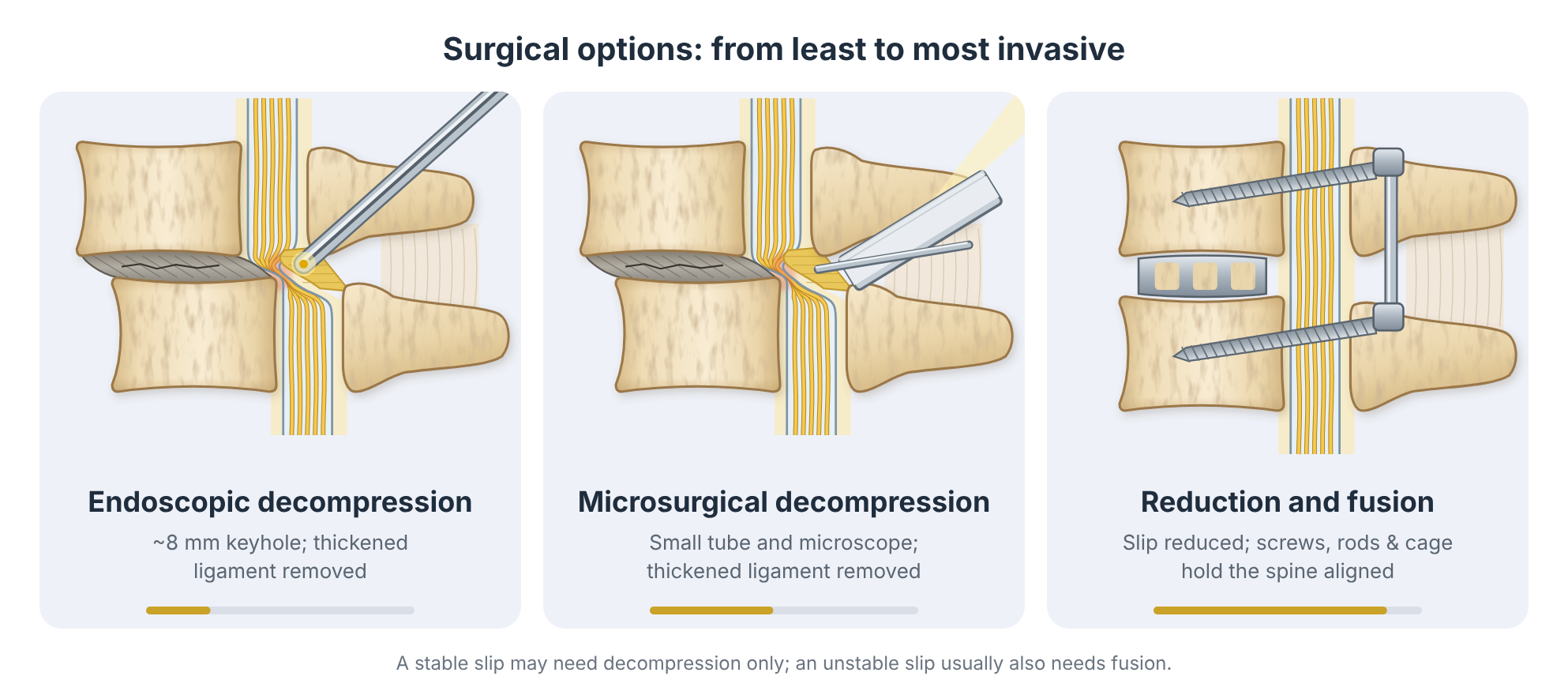
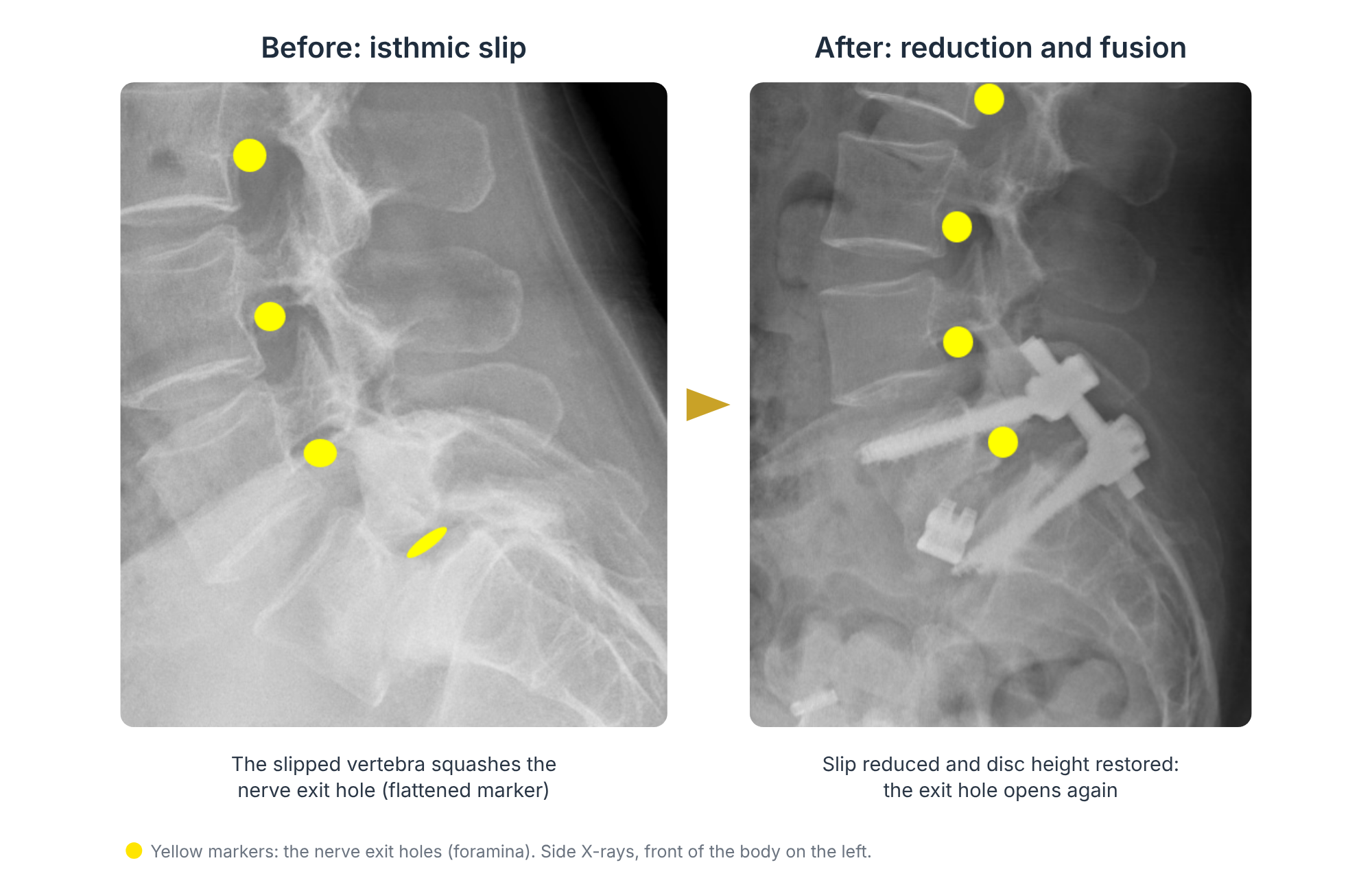
Endoscopic and minimally invasive decompression
For a stable, low-grade degenerative slip, the nerves can be freed through small incisions while preserving the joints and ligaments that hold the spine together. This lowers the risk of making the slip worse.
Open decompression
Removal of thickened ligament and bone pressing on the nerves through a midline approach under the microscope.
Decompression with fusion
Fusion holds the slipped vertebra in place with screws and rods, usually with a cage in the disc space (interbody fusion). It can be performed open or through minimally invasive approaches from the back, side or front. Fusion is generally recommended for isthmic spondylolisthesis that needs surgery, for unstable (mobile) degenerative slips, for higher-grade slips and when there is significant back pain from the unstable segment.
Disc replacement
Disc replacement is not suitable for spondylolisthesis because the segment is already unstable.
What the evidence says: SPORT degenerative spondylolisthesis
In SPORT, patients with degenerative spondylolisthesis and stenosis who had surgery (mostly decompression with fusion) improved substantially more in pain and function than those treated non-surgically, with benefits maintained at 4 and 8 years.
What the evidence says: Decompression alone or with fusion?
The SLIP trial (Ghogawala and colleagues, NEJM 2016) found that adding fusion gave slightly better physical-health scores and fewer reoperations over 4 years. In contrast, the Swedish trial (Försth, NEJM 2016) and the Norwegian NORDSTEN trial (Austevoll, NEJM 2021) found that decompression alone was as good as decompression with fusion for most patients with a degenerative slip. Today, fusion is usually reserved for slips that are unstable or associated with significant back pain, while stable slips are often treated by decompression alone.
What the evidence says: Isthmic spondylolisthesis in adults
A Swedish randomised trial (Möller and Hedlund, Spine 2000) found that posterolateral fusion gave better pain relief and function than an exercise programme for adults with symptomatic isthmic spondylolisthesis.
Recovery
After decompression alone, most people go home within 1 to 2 days. After fusion, the hospital stay is usually 2 to 4 days, with a gradual return to activity over 3 months while the bone heals. Most patients report substantial improvement in leg pain and walking.
Talk to Prof Kruger
If you are living with this condition and would like an opinion on your options, you are welcome to book a consultation. Please bring any recent scans and reports.
References and key studies
- Weinstein JN, et al. Surgical versus nonsurgical treatment for lumbar degenerative spondylolisthesis. N Engl J Med. 2007;356(22):2257–2270.
- Weinstein JN, et al. Surgical compared with nonoperative treatment for lumbar degenerative spondylolisthesis: four-year results in the SPORT randomized and observational cohorts. J Bone Joint Surg Am. 2009;91(6):1295–1304.
- Abdu WA, et al. Long-term results of surgery compared with nonoperative treatment for lumbar degenerative spondylolisthesis in the Spine Patient Outcomes Research Trial (SPORT). Spine. 2018;43(23):1619–1630.
- Ghogawala Z, et al. Laminectomy plus fusion versus laminectomy alone for lumbar spondylolisthesis. N Engl J Med. 2016;374(15):1424–1434.
- Försth P, et al. A randomized, controlled trial of fusion surgery for lumbar spinal stenosis. N Engl J Med. 2016;374(15):1413–1423.
- Austevoll IM, et al. Decompression with or without fusion in degenerative lumbar spondylolisthesis. N Engl J Med. 2021;385(6):526–538.
- Möller H, Hedlund R. Surgery versus conservative management in adult isthmic spondylolisthesis: a prospective randomized study. Spine. 2000;25(13):1711–1715.
This page is general patient education based on published research and is not a substitute for a personal consultation. Treatment is always tailored to the individual.